



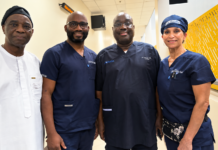
















Surgeons in Nigeria carried out Nigeria’s first tele-robotic surgery Saturday, removing a cancerous kidney from a patient at Nisa Premier Hospital while the operating surgeon controlled the procedure in real time from a console located across the city at the Redeemer’s Health Village.
The operation, a telesurgery-assisted robotic right radical nephrectomy, was led by Obi Ekwenna-Davis, a professor of urology and transplantation and co-founder of RoboMed Global, the U.S.-based firm that partnered with the two Nigerian hospitals on the procedure. Ekwenna-Davis directed the operation remotely using a Toumai surgical console, guiding robotic instruments inside the patient more than a kilometer away in real time.
“Distance should never decide who receives safe surgery; this is what safe and trusted surgery looks like,” Ekwenna-Davis said following the roughly three-hour procedure, which included brief pauses built in to confirm the equipment and connectivity were functioning as intended. He said the patient was in good condition afterward and was expected to be discharged within 24 hours.
The Eastern Updates understands the collaboration marks the first time two hospitals in different parts of Nigeria have jointly delivered surgical care through a single remote-controlled operation, a structure Ekwenna-Davis described as demonstrating that telesurgery can be performed safely on patients regardless of their location within the country or beyond it. He said the achievement carried particular weight for the two institutions and their partners because it proved the underlying technology and coordination could work reliably outside of a controlled pilot setting.
Read Also: Enugu Finds No Confirmed Diphtheria Case After Scare
Adedamola Dada, chief executive of the Redeemer’s Health Village, said the operation represented the first telesurgery procedure carried out anywhere in West Africa and reflected the hospital’s broader mission of delivering advanced care at accessible cost. “What has happened today is a demonstration that Nigerians can access modern healthcare without travelling abroad,” Dada said, describing the initiative as consistent with the vision of the Redeemed Christian Church of God, which established the faith-based, 300-bed facility.
Dada said the hospital’s ambitions extend beyond a single demonstration procedure. Redeemer’s Health Village is establishing a robotic surgery academy in partnership with RoboMed Global to train doctors, nurses, biomedical engineers and other specialists, with an initial target of training at least 150 surgeons within two years. He said the effort had the backing of Nigeria’s health minister and other government bodies, and called on private companies and non-governmental organizations to help fund additional training slots.
“My message to government is to support and sponsor Nigerians, the surgeons, the nurses, the biomedical engineers who would want to come and do this training here,” Dada said, suggesting scholarships could allow Nigeria to build a substantial pool of robotic surgery specialists within a few years rather than relying on doctors trained abroad.
Ibrahim Wada, chief executive and founder of Nisa Premier Hospital, where the patient underwent the procedure, said the facility has functioned as a hub for robotic surgery in the region since November 2025. “Today, our patient received specialist surgical expertise from across the country without leaving Abuja. This is what becomes possible when Nigerian institutions decide to build together,” Wada said.
Reliable connectivity remains one of the central technical challenges facing any expansion of telesurgery in Nigeria, according to Dada, who said weather conditions can sometimes interfere with the network links the procedure depends on. He said the hospitals had put measures in place to guard against such disruptions, alongside investment in equipment quality and personnel training, both of which he described as equally critical to the success of any future remote operation.
Read Also: WHO Sees Ebola Slowing In Congo, Warns Fight Isn’t Over
Kunle Onakoya, chairman of the board of Redeemer’s Health Village, called Saturday’s procedure historic and urged those involved to recognize their role in what he described as a milestone moment for Nigerian healthcare. Journalists were permitted to observe the operation live via television feed from the hospital, where hospital staff and partners gathered to watch the procedure unfold in real time.
Nigeria has historically ranked among the countries with the highest volumes of outbound medical tourism in Africa, with patients traveling abroad for specialist cancer, cardiac and transplant procedures that domestic facilities have often lacked the equipment or expertise to perform. Dada framed Saturday’s operation as a direct answer to that pattern, arguing that telesurgery infrastructure built around a small number of highly trained specialists could eventually extend advanced surgical care to patients in cities without their own resident specialists, provided hospitals can secure the network reliability and equipment investment the model requires.
The hospitals involved say the technology’s next test will be scaling it — extending the model beyond a single high-profile case toward routine use across more of the specialist procedures that currently send Nigerian patients abroad for treatment they might otherwise receive at home.