

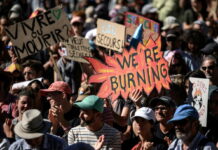



















Several thousand people marched through the Swiss cities of Geneva and Lausanne on Saturday, demanding stronger government action on climate change under the banner “No 50-degree summers!”
The demonstrations were organized by a coalition of more than 100 associations and political parties, drawing participants of all ages who carried signs reading “No Planet B” and “We’re cooked!” Organizers said at least 8,000 people took part in the larger of the two marches, held in Lausanne.
The Eastern Updates has gathered that the protests follow a summer in which Switzerland’s heatwaves forced the closure of a nuclear power station and pushed water levels in Lake Zurich to record lows, conditions organizers say illustrate the urgency behind Saturday’s turnout.
Guillaume Matthey, a 31-year-old union activist who joined the Lausanne march, said he hoped the demonstration would mark “a new cycle of widespread popular mobilization” aimed at pressuring the country’s political and financial leadership to act. Another marcher, 60-something protester Yves Froidevaux, framed the demonstration as a direct message to officials: “This is about telling our authorities that it’s really the time to act.” He added that public spending priorities needed to shift, saying governments “can’t just finance weapons and then not care about the rest of it.”
The marches carry particular weight in Switzerland given its legal history on the issue. In 2024, the European Court of Human Rights ruled that the Swiss government was not doing enough to combat climate change, marking the first time an international court had ruled against a country on the matter. The case, brought by a group of older Swiss women known as the KlimaSeniorinnen, found that Switzerland’s climate policies violated the European Convention on Human Rights by failing to adequately protect citizens from the health effects of global warming. The ruling has not compelled binding new legislation in the two years since, a gap demonstrators cited as part of their grievance.
Read Also: UN Warns Earth Could See Hottest Years On Record By 2031
Participants described the practical toll of the summer’s heat directly. Vincent Fontannaz, a 47-year-old actor who marched dressed as a giant drop of water, pointed to water scarcity as a central concern, saying the shortage extended well beyond recreational use. “It’s not just about swimming pools, it’s most of all about agriculture — and for our survival, in fact,” he said.
Laurent Guidetti, a 55-year-old architect who wore a gas mask fashioned from plastic bottles, said he had spent much of the summer thinking about residents without access to well-insulated housing. Guidetti described his own apartment as staying cool overnight, a comfort he said many in the city could not count on. He said he did not know how those without such protection would manage as temperatures climb further in coming summers.
Switzerland’s domestic energy and water infrastructure has faced mounting strain during the country’s recent heatwaves. The shutdown of a nuclear plant during peak summer heat this year forced adjustments to the country’s power supply, while Lake Zurich’s water levels fell to levels not previously recorded, according to organizers who cited the events as evidence of accelerating climate pressure on Swiss infrastructure.
Saturday’s demonstrations are not intended as a single event. Organizers have scheduled additional protests in several Swiss cities over the coming weeks, running through October 2, extending what Matthey described as an effort to sustain pressure on officials beyond a single weekend of marching.
The coalition behind the protests has not detailed specific policy demands beyond calling for accelerated climate action, though the involvement of more than 100 organizations signals a broad base spanning environmental groups, political parties and civic associations. Swiss federal authorities have not issued a formal response to Saturday’s demonstrations.
Read Also: Don’t Politicise Flooding – Lagos Govt Warns Critics
The Geneva and Lausanne marches add Switzerland to a growing list of European countries that have seen large-scale climate demonstrations this year, as record heat and its strain on water and energy systems have pushed the issue back toward the center of public debate in several capitals.
Switzerland’s exposure to warming has drawn particular scientific attention because of its glaciers, which have lost a substantial share of their volume over the past several decades and continue shrinking each summer the country records extreme heat. Researchers who track alpine glacial retreat have linked accelerated melt directly to the kind of prolonged high-temperature periods Switzerland experienced this year, adding a visible marker to a debate that demonstrators say still lacks a matching political response.
For a small, land-locked country with no coastline, the domestic stakes of the marches center less on temperature records themselves and more on strained systems — water for farms, cooling for aging infrastructure, and reliable power during peak demand — that organizers argue the current political response has not kept pace with.