


















|
Listen to article
|
President Bola Tinubu has vowed never to succumb to terrorism, banditry or any form of criminal intimidation, promising to intensify efforts at reducing the economic hardship confronting Nigerians.
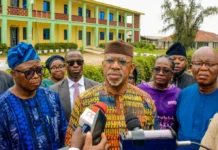
Tinubu made these remarks through the Secretary to the Government of the Federation, George Akume, on Sunday at the National Inter-Denominational Church Service held at the National Christian Centre in Abuja, as part of activities marking the 2026 Democracy Day celebration.
The service, themed “God of Hope, Actualise Our Dreams,” was attended by Senate President Godswill Akpabio, Deputy Speaker of the House of Representatives Benjamin Okezie Kalu, Minister of Foreign Affairs Bianca Odumegwu-Ojukwu, and the Head of Civil Service of the Federation, Mrs. Didi Walson-Jack.
The SGF, while delivering President Tinubu’s message, congratulated Nigerians on 27 uninterrupted years of democratic rule since 1999, describing the milestone as a testament to the resilience and sacrifices of citizens who fought for the restoration of democracy.
Read Also: Umahi Unveils New Security Plan For Key Nigerian Highway
He paid tributes to pro-democracy activists of the June 12 struggle, noting that many endured persecution, injuries and death in that quest.
According to him, the government was fully aware of the economic strain, insecurity, kidnappings and displacement affecting communities across the country.
“The government is sensitive to all these pains, shares in these pains and has heard your cries,” he said, adding that Tinubu was addressing the challenges with compassion and a strong sense of responsibility.
Speaking on security, the President described recent attacks and abductions as painful reminders that more work remained to be done, but assured citizens that the safe return of all persons in captivity remained a national priority.
He added security agencies were being supported with the necessary resources to protect lives, secure communities and preserve Nigeria’s territorial integrity.
“The government of Nigeria shall never succumb to terror, banditry or any form of criminal intimidation,” he declared.
Nigeria’s federal government has designated the Mararaba-Keffi Road as the testing ground for a nationwide highway surveillance program that, if rolled out as planned, would install closed-circuit television cameras along every major transportation corridor in the country — an ambition Works Minister David Umahi framed Saturday as a direct presidential directive, not a ministry initiative.
The scope of what President Bola Tinubu is asking for is considerable.
Umahi, speaking during a site inspection of the Mararaba-Keffi reconstruction project, said the president wants CCTV coverage on all federal routes — and that the Abuja-Keffi corridor will serve as the template for how that coverage is built and operated.
The surveillance infrastructure, he said, would be solar-powered, integrated with observation facilities, and linked to security agencies capable of monitoring road activity in real time. Rapid-response mechanisms would be embedded in the system to reduce emergency response times on highways where incidents currently go undetected for extended periods. The program will not rely on the police alone.
Umahi disclosed that the federal government is working with the Nigeria Police Force to revive the Highway Patrol and Safety Unit — a department that has existed on paper within the police structure but has functioned at diminished capacity for years.
The CCTV network, in the minister’s framing, is the hardware side of a security architecture that requires the highway patrol’s revival as its human infrastructure. One without the other, he suggested, produces surveillance footage without the response capacity to act on it.
The Mararaba-Keffi corridor connects the Federal Capital Territory to Nasarawa State and carries heavy daily traffic through one of the more congested approach routes into Abuja. Its selection as the pilot site reflects both its strategic visibility and its ongoing reconstruction — conditions that allow surveillance infrastructure to be embedded during active construction rather than retrofitted after completion. Umahi drew a direct parallel to the second Niger Bridge, which he said had been equipped with similar observation and CCTV capacity as a reference model.
The construction itself has produced results that the minister found worth acknowledging publicly.
Read also: Umahi: Federal Road Projects Unaffected By Bandit Activity
JRB Construction Limited, an indigenous Nigerian firm handling approximately 40 kilometers of the road, has completed roughly 21 kilometers of binder course within eight months — progress Umahi described as creditable given that the company mobilized to the site and began work before receiving full payment from the government. That sequencing — contractor absorbs financial risk to prevent project delay — is not standard practice in Nigeria’s federal roads sector, where funding disbursement delays have historically stalled projects for months or years. Umahi called JRB one of the most reliable indigenous contractors in the country, citing both the quality of its equipment and its willingness to operate under fiscal uncertainty.
That commendation arrived alongside a warning directed at contractors less willing to do the same.
The minister said the government would shortly begin a systematic performance review of all contractors handling federal road projects, with no exemption for either indigenous or foreign firms.
Companies that had collected mobilization funds without deploying equipment, commencing work, or demonstrating measurable progress would, he said, no longer be accommodated. “We are going to identify those contractors who are genuine partners in progress and those who simply wait for mobilisation funds before doing any work,” Umahi said. The review is intended to cull the roster of federal road contractors to those the government regards as functional partners rather than rent-seekers on public infrastructure budgets.

