















|
Listen to article
|
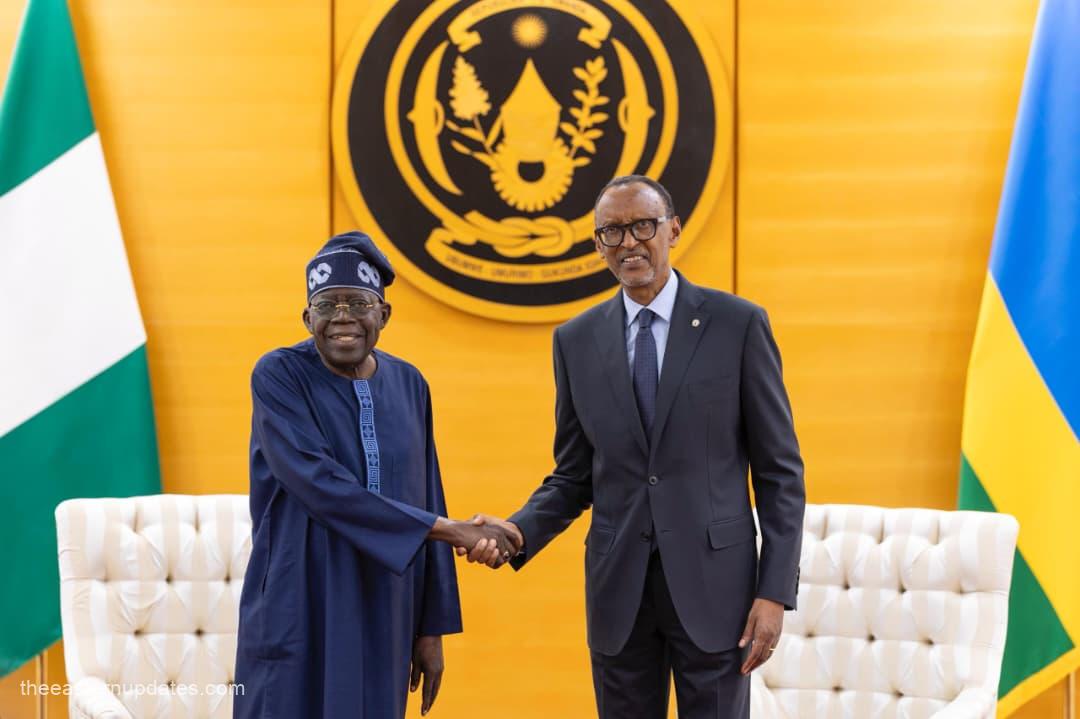
President Bola Tinubu arrived in Kigali on Wednesday for the Africa CEO Forum and used the occasion for a high-level meeting with Rwandan President Paul Kagame at the Urugwiro Presidential Villa — a bilateral encounter that produced commitments to revive dormant cooperation frameworks, open aviation cargo negotiations and advance visa liberalization between two countries whose diplomatic relationship has moved more slowly than its stated ambitions.
The two leaders agreed to reinvigorate the Joint Permanent Ministerial Commission signed between Nigeria and Rwanda in 2021, a platform designed to drive cooperation across strategic sectors that has not delivered the implementation pace either government intended. Both presidents pledged to accelerate activation of pending agreements covering tourism, anti-corruption coordination and the fight against illicit drugs — a category of diplomatic promise that tends to accumulate at bilateral summits and dissolve in the bureaucratic space between them. The explicit commitment to “measurable results” in the post-meeting framing suggests an awareness on both sides that the credibility problem is real.
Tinubu signaled that Nigeria would seriously consider matching Rwanda’s existing 30-day visa-free policy for Nigerian citizens — a reciprocal arrangement that would lower barriers for business travel, tourism and the kind of people-to-people exchange that Pan-African integration rhetoric invokes but rarely operationalizes. Rwanda has been among the more aggressive movers on African free movement, and a Nigerian reciprocal visa policy would carry continental significance given Nigeria’s size and the volume of its diaspora movements across the continent.
The African Continental Free Trade Area featured in the bilateral discussions as a shared instrument rather than an abstract commitment.
Tinubu and Kagame exchanged positions on how their two countries could use the AfCFTA framework to increase commerce, stimulate industrial growth and create jobs — a conversation that is more useful than it might appear, given that Nigeria’s domestic implementation of AfCFTA obligations has been among the more contested aspects of the agreement’s rollout.
Read also: DRC, Rwanda Pledge De-escalation Steps In US-Brokered Talks
On aviation, Nigeria is opening talks with RwandAir to establish cargo and export channels for Nigerian businesses operating across Africa. The initiative follows a similar air cargo corridor Tinubu’s administration launched with Uganda Airlines — a pattern of bilateral aviation agreements designed to build the physical infrastructure that trade agreements require but rarely create on their own. Intra-African trade has been constrained for decades not only by tariff barriers but by the absence of affordable, reliable freight connections between markets, and the cargo corridor strategy addresses that problem one airline relationship at a time.
Tinubu’s reception at Kigali International Airport included Nigeria’s Foreign Affairs Minister Bianca Odumegwu-Ojukwu and Rwanda’s Defence Minister Juvenal Marizamunda — a welcoming delegation that signaled the bilateral dimension of the visit was being taken seriously alongside the multilateral forum that provided its context.
The Africa CEO Forum, where Tinubu is scheduled to speak on Nigeria’s reform agenda, is one of the continent’s most significant annual gatherings of investors, policymakers and business leaders.
This year’s theme — The Scale Imperative: Why Africa Must Embrace Shared Ownership — reflects a maturation in continental business discourse that has moved from celebrating Africa’s growth potential to interrogating why that potential consistently fails to translate into the scale of investment and industrial development the projections promise. Tinubu’s planned address will offer him a platform to make the case that Nigeria’s ongoing economic reforms — fuel subsidy removal, exchange rate unification, tax restructuring — represent genuine recalibration rather than fiscal turbulence, a distinction that matters enormously to the foreign and African institutional investors in the room.
Read also: Rwanda UK Asylum Deal Arbitration Sparks Legal Clash
The Kigali visit came directly after Tinubu’s participation in the Africa-France Summit, placing it within a diplomatic sequence that has kept the Nigerian president in active continental engagement across consecutive engagements. For Rwanda, receiving one of Africa’s most consequential leaders for a substantive bilateral before the forum’s main programming is itself a signal about Kigali’s growing centrality as a hub for African business and governance diplomacy — a status Kagame has been deliberately constructing for years through investment in infrastructure, safety, efficiency and the kind of institutional predictability that continental forums reward with their choice of venue.
Whether the Kigali agreements follow the trajectory of the 2021 Joint Commission — signed with ambition, implemented with difficulty — or produce the faster activation both presidents pledged will be determined in the ministries rather than the presidential villas where the commitments were made.