

















|
Listen to article
|
Iran said its latest wave of attacks on Thursday had targeted the UAE, Bahrain and Israel after US-Israeli strikes hit the country’s two largest steel plants.
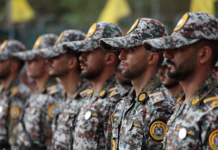
“In response to attacks on Iranian steel industries, the Islamic Revolutionary Guard Corps launched a new wave of attacks this morning,” the military’s central command, Khatam Al-Anbiya said in a statement carried by state TV.
“American steel industries in Abu Dhabi, American aluminium industries in Bahrain, and the Rafael arms factories of the Zionist regime” were among a number of targets, it said.
Read Also: Spain Shuts Airspace To U.S. Iran War Flights
Quoting the Revolutionary Guards’ navy command, Tasnim news agency also said the data centres of two US firms — Oracle in Dubai and Amazon in Bahrain — were targeted.
Spain closed its airspace to all U.S. military aircraft involved in the war on Iran on Monday, extending a ban that already covered two jointly operated American bases on Spanish soil into a broader restriction that forces Washington to reroute its Middle East operations around a NATO ally for the first time since the conflict began.
Defence Minister Margarita Robles confirmed the closure to reporters in Madrid, making clear it had been communicated to American military and diplomatic counterparts from the outset rather than constituting a new escalation.
“This was made perfectly clear to the American military and forces from the very beginning. Therefore, neither the bases are authorized, nor, of course, is the use of Spanish airspace authorized for any actions related to the war in Iran,” she said, describing the conflict as “profoundly illegal and profoundly unjust.”
Foreign Minister José Manuel Albares confirmed the expanded ban, telling Catalan radio station Rac 1 that Madrid would block any U.S. flights linked to the conflict from entering Spanish airspace. “Spain should not do anything that could escalate” the conflict, Albares said. Economy Minister Carlos Cuerpo provided the government’s legal framing. “This decision is part of the stance already taken by the Spanish government not to participate in or contribute to a war initiated unilaterally and in violation of international law,” he said in a separate interview. Emergency flights are exempt from the prohibition.
Read Also: Anti-Trump Protests Launch On ‘No Kings’ Day In US
The practical consequences are operationally significant. U.S. military aircraft must now reroute around Spanish territory, increasing flight times, fuel consumption, and logistical complexity for operations across the Middle East theater. Spain’s Naval Station Rota on the Atlantic coast serves as one of the U.S. Navy’s most important European logistics hubs, hosting Aegis-equipped destroyers and serving as a critical transit point for forces and equipment moving between American ports and the Mediterranean. Moron Air Force Base near Seville similarly functions as a staging platform for air mobility operations across Europe and Africa. Neither facility can now be used for any activity connected to the Iran war.
The move represents a historic departure from precedent among U.S. allies. In 2003, Turkey refused ground access for the invasion of Iraq but still allowed American overflights. France and Germany, despite their fierce opposition to that war, permitted U.S. and British fighter jets to cross their airspace. France’s then-Foreign Minister Dominique de Villepin told parliament at the time that “there are practices between allies that exist that we must respect, including overflight rights.” Spain’s refusal to honor even that minimum convention marks an assertion of sovereign legal authority over alliance obligations that has not been seen from a NATO member in the modern era of the Atlantic alliance.