



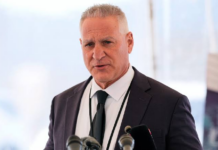















Prime Minister Benjamin Netanyahu said Iran, Hamas, and Hezbollah no longer pose significant threats in the region due to Israel’s degradation of their capabilities.
Netanyahu spoke on Sunday at the IDF Northern Command, where he visited alongside Defense Minister Israel Katz and IDF Chief-of-Staff Lt. Gen. Eyal Zamir.
“Iran is not the same Iran, Hezbollah is not the same Hezbollah, and Hamas is not the same Hamas,” he declared, saying “terrorist armies” are now “battered enemies” fighting for survival.
Commending IDF commanders for their participation in Israel’s “multi-arena campaign,” Netanyahu said Israel stepped up “surprising” and “attacking” its adversaries to prevent offensives.
The premier said the “immense force” against Iran and its proxies was achieving “great accomplishments,” crediting the achievements for the “visible cracks in the terrorist regime in Tehran.”
Netanyahu recalled how former Hezbollah secretary-general Hassan Nasrallah, who was eliminated in 2024, created a massive force with the intention of perpetrating carnage in Israel.
“We eliminated Nasrallah; thousands of Hezbollah terrorists,” he boasted. “We eliminated the immense threat of 150,000 missiles and rockets that were intended to destroy the cities of Israel.
But Netanyahu emphasized that Hezbollah still has “a residual capability to launch rockets,” revealing his discussions with IDF commanders focused on ways to remove the threats.
Meanwhile, N12, an Israeli news platform, has reported the government’s plans to invite the United States to move some of its Middle East bases to Israel and build new ones after the war.
However, European leaders on Sunday criticized Netanyahu for allegedly preventing Catholics from celebrating Palm Sunday in Jerusalem’s Holy Places.
Spanish Prime Minister Pedro said the action was done “without any explanation, reasons or motives,” stressing that coexistence is impossible without tolerance,
“We condemn this unjustified attack on religious freedom and demand that Israel respect the diversity of beliefs and international law,” Sánchez wrote in a post on X.
Canada’s Prime Minister Mark Carney similarly faulted Israel’s decision to block the Latin patriarch of Jerusalem from marking Palm Sunday at the Church of the Holy Sepulchre.
Carney said the act “further violates the longstanding status quo of Jerusalem’s Holy Sites,” adding that people of every faith in Jerusalem should be able to worship freely and without fear.
Britain, France, Germany and Italy expressed “deep concern” on Sunday over Israeli plans to extend the application of the death penalty in a bill due to be voted into law next week.
Their statement came the same day the Council of Europe rights body also issued a statement against the draft law.
“We… express our deep concern about a bill that would significantly expand the possibilities to impose the death penalty in Israel and that could be voted into law next week,” said a joint statement by the countries’ foreign ministers.
“We are particularly worried about the de facto discriminatory character of the bill.
“The adoption of this bill would risk undermining Israel’s commitments with regards to democratic principles.”
The far-right government is due to put its bill to a second and third reading in the Knesset — the Israeli parliament — on Monday. If it passes, it will almost certainly face a legal challenge and go before the Supreme Court.
Also Sunday, Council of Europe chief Alain Berset issued an appeal to Israel over the draft law.
“The Council of Europe opposes the death penalty in all places and in all circumstances,” he said.
“The texts currently under examination in the Knesset would represent a grave step backwards from Israel’s long-standing de facto moratorium,” he added, calling on the authorities to abandon the planned law.
While the death penalty exists for a small number of crimes in Israel, it has become a de facto abolitionist country: the last person to be executed was the Nazi Holocaust perpetrator Adolf Eichmann in 1962.
The amendment, called for by Israel’s far-right National Security Minister Itamar Ben Gvir, would introduce mandatory death sentences for certain offences.
In February, a dozen UN rights experts argued that this would introduce two tracks for the death penalty in Israel.
“By removing judicial and prosecutorial discretion, they prevent a court from considering the individual circumstances, including mitigating factors, and from imposing a proportionate sentence that fits the crime,” they said.
In the occupied West Bank, their statement said “the death penalty would be imposed by military courts under military law for terrorist acts causing the death of a person, even if not intended”.

