
















|
Listen to article
|
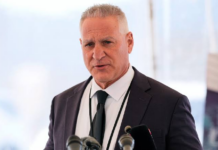
Israeli Finance Minister Bezalel Smotrich declared Monday that Israel’s northern boundary should be redrawn to the Litani River, pushing some 30 kilometers into Lebanese territory, as the Israeli military struck additional crossings on that river and continued to demolish homes in southern Lebanon in an operation now entering its fourth week.
The remarks were the most direct statement yet by a senior Israeli official explicitly advocating territorial annexation of southern Lebanon, framing military objectives in the country not merely as a security operation against Hezbollah but as a permanent redefinition of sovereign borders.
“I say here definitively — in every room and in every discussion, too: the new Israeli border must be the Litani,” Smotrich said during an Israeli radio interview Monday. The military campaign in Lebanon, he added, “needs to end with a different reality entirely, both with the Hezbollah decision but also with the change of Israel’s borders.”
Prime Minister Benjamin Netanyahu’s office did not respond to a request for comment on the remarks. Smotrich leads a small far-right party within Netanyahu’s governing coalition and has a history of public statements that outrun official government policy. Still, his position on the Litani River as a future Israeli border did not emerge in isolation.
Defense Minister Israel Katz had earlier this month suggested that Lebanon could face “loss of territory” if it failed to disarm Hezbollah. Katz also ordered the destruction of all crossings over the Litani River and directed the military to expand demolitions of homes near the southern border. Israeli and U.S. officials, speaking to Axios last week, confirmed that Israel is planning a large-scale operation to seize the entire area south of the Litani River, with one senior Israeli official stating: “We are going to do what we did in Gaza.”
Read Also: Israel Targets Hamas Police In Gaza As Ceasefire Strains Further
On Monday, Israeli strikes hit two additional Litani crossings — a road near a main bridge struck the day before and a smaller bridge on another section of the river. Hanna Amil, the mayor of the Christian border town of Rmeish, whose residents have refused to evacuate, told Reuters conditions were deteriorating sharply. “Once or twice a week, a convoy from the Lebanese army accompanies us as we try to get basic goods from nearby areas,” Amil said. “Already, we have no state electricity, no water and we have diesel shortages. If all the routes to the north get cut off, who knows what the future could hold for us.”
Lebanese authorities say the Israeli campaign has killed more than 1,000 people and displaced close to one million, approximately 19 percent of the country’s entire population, since fighting erupted on March 2 when Hezbollah fired missiles into Israel. The Lebanese government has publicly condemned Hezbollah for initiating attacks without state authorization and has banned the group’s military activities, calling on it to surrender its weapons to state control.
Israel issued evacuation orders for all residents south of the Litani on March 5, followed the next day by orders for residents of Hezbollah’s stronghold in Beirut’s southern suburbs to leave. Ground operations formally began on March 16, with the IDF advancing beyond at least five positions it has occupied in Lebanon since November 2024.
Read Also: Israel Strikes Iran’s Gas Field In Major War Escalation
For Lebanon, Smotrich’s explicit claim on the Litani River carried particular weight given the country’s history with its neighbor. Israeli forces launched their first major incursion to that river in 1978 under Operation Litani, and subsequently occupied a broad swath of southern Lebanon from 1982 until a withdrawal in 2000, during which a proxy militia, the South Lebanon Army, administered the zone on Israel’s behalf. The current military campaign tears up the framework established by United Nations Security Council Resolution 1701, which ended the 2006 war and required Israeli withdrawal while limiting Hezbollah’s armed presence in the south.
A Lebanese official told Reuters that Beirut continues to rely on foreign powers to apply sufficient pressure on Israel to end the fighting, including through an offer by President Joseph Aoun to hold direct talks.
The United Nations human rights chief has criticized Israel’s actions in Lebanon, noting that international law generally prohibits military attacks on civilian infrastructure. The destruction of Litani crossings has drawn particular scrutiny given their role in supplying basic goods to communities in the south that have not evacuated.
Monday’s remarks also extended to Gaza. Smotrich called for Israel to formally annex the territory it currently controls in the Gaza Strip, up to the armistice line with Hamas. Under a ceasefire agreement reached in October, Israel retained control of approximately 53 percent of Gaza, from which it has ordered residents to leave and where it has carried out widespread demolitions.
The Lebanese government has not issued a formal response to Smotrich’s border remarks. President Aoun’s proposal for direct talks with Israel remains on the table, and Lebanese officials said they were waiting to gauge whether international diplomatic pressure would be sufficient to halt the advance before any formal negotiations could begin.