














|
Listen to article
|
Officers of the Nigeria Customs Service Apapa Area Command intercepted 339,800 bottles of codeine-based cough syrup valued at N3.398 billion at Apapa Port on Sunday, five days after the service’s Comptroller-General visited the terminal and declared it would no longer serve as a transit point for smugglers, in what port officials described as a direct operational response to the CGC’s directive.
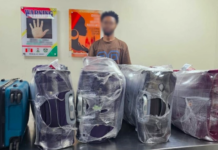
The operation on March 15, 2026, was executed in collaboration with the National Drug Law Enforcement Agency at what port officials described as Nigeria’s busiest seaport. During the intelligence-driven inspection, officers uncovered two containers packed with 3,398 cartons of codeine-containing syrup, cleverly hidden inside shipments of household utensils in a deliberate attempt to evade detection. The seized items carry a Duty Paid Value of N3,398,000,000.
Container MRKU 3816476 contained 1,700 cartons, equivalent to 170,000 bottles, of codeine syrup concealed alongside 38 cartons of pearl-plated insulated casseroles and bullet insulated hotspot containers. The second container, TGBU 5399178, held 1,698 cartons equaling 169,800 bottles of the same substance, hidden within 36 cartons of pearl-plated household casseroles. Both containers have been converted to seizure under the Nigeria Customs Service Act 2023 as amended.
Apapa Area Controller Comptroller Emmanuel Oshoba explicitly linked the operation to Comptroller-General Bashir Adeniyi’s visit to the port the previous Tuesday.
“This fresh seizure, coming just five days after the CGC’s visit and strong warning to criminal elements, is a direct response to his charge on us. We are fully aligned with the Service’s intelligence-led enforcement strategy and will continue to make Apapa Port extremely hostile to smugglers and drug traffickers,” Oshoba said.
During his March 10 visit, Adeniyi announced the interception of 13 containers of pharmaceutical products and other goods with a combined value of N6.3 billion — a haul he cited as evidence that criminal networks had been using legitimate trade documentation as cover for large-scale pharmaceutical smuggling through Apapa’s terminal infrastructure.
“Apapa Port is no longer a playground for smugglers or criminal syndicates hiding behind legitimate trade documentation,” he declared at the time. Sunday’s codeine seizure means the Apapa command has intercepted pharmaceutical contraband worth nearly N9.7 billion within a single week.
Command spokesperson Isah Sulaiman said the operation had been conducted on the basis of prior intelligence rather than random inspection. The codeine containers had been placed on a watch list by NDLEA following information about the concealment method before they were flagged for joint examination. The choice of household utensils — in this case casseroles and insulated containers used for food storage — as concealment vehicles reflects a recurrent pattern in pharmaceutical smuggling through Nigerian seaports, in which consumer goods with high import volumes are used to create visual and dimensional cover for drug shipments. The weight and density profile of casseroles is broadly similar to that of closely packed bottles, making the substitution difficult to detect without physical examination or scanning.
The codeine seized is the controlled pharmaceutical compound codeine phosphate formulated as a cough suppressant in syrup form, marketed under the product name CSP Codeine. At legal prescription strengths, codeine is a clinically recognized opioid antitussive used to treat severe coughs. In Nigeria’s illicit market, it is predominantly abused by mixing with carbonated drinks and other substances, a practice associated with profound central nervous system depression, addiction, respiratory failure, and death in overdose cases. The scale of demand for illicit codeine in Nigeria’s northern states — where the pattern of mixing codeine syrup with drinks originated and has been most extensively documented — has driven a parallel import economy that has persistently outpaced enforcement, regulation, and pharmaceutical channel controls.
Nigeria banned the retail sale of high-strength codeine syrup — specifically preparations containing more than 15 milligrams of codeine per 5 milliliters — in 2018 following a BBC Africa Eye documentary that exposed the scale of the abuse epidemic. The ban covered domestic manufacture and importation for retail use, though codeine remains legally available in hospital and clinical settings under strict prescription controls.
Read Also: Kano Customs Seizes N1bn In Contraband Over 10 Weeks
The 2018 ban created a price premium in the illicit market that incentivized large-scale smuggling through official port infrastructure using exactly the concealment techniques documented in Sunday’s seizure.
The Customs Area Controller said the operation reflects the command’s dedication to implementing the directives and strategic vision of the NCS. “This operation reflects our intelligence-led approach and commitment to making Apapa Port extremely hostile to smugglers and drug traffickers,” Oshoba said. He commended NDLEA officials for what he described as their “seamless collaboration and unwavering support” in the operation, noting that inter-agency coordination was critical to successful drug enforcement at a port the scale of Apapa.
Read Also: Two Customs Officers Held Over Driver’s Death On Osogbo Road
The two operations this week — the March 10 pharmaceutical seizure and Sunday’s codeine interception — represent the Apapa command’s most visible enforcement record in a single calendar week in recent years and demonstrate the increased operational tempo that followed the CGC’s terminal visit. Port industry sources say Adeniyi’s decision to personally visit and publicly commit to zero tolerance enforcement has raised operational pressure on both enforcement staff and on criminal networks that have historically been able to manage customs inspection risk through bribery and connections. Whether the pressure is sustained after the CGC’s public focus moves elsewhere will be the determinative factor in how much the Apapa command’s seizure record reflects lasting institutional change rather than a short-term response to leadership visibility.
No arrests of cargo owners or importers connected to either container were announced in the command’s statement. The containers have been formally seized and will be held pending investigation. A potential consignee or consignor has not been identified in any public statement from either the Customs command or NDLEA.