









|
Listen to article
|
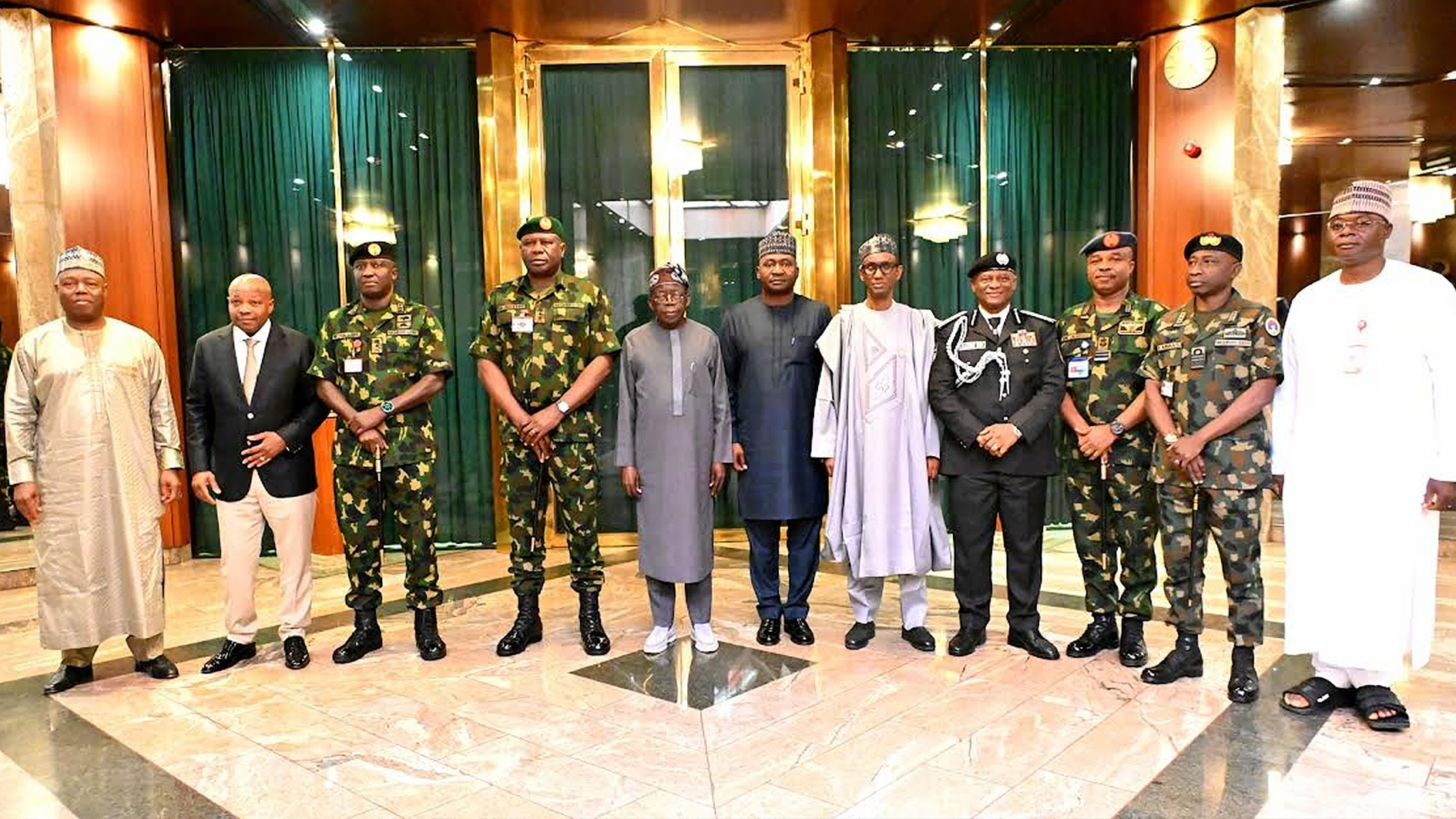
President Bola Tinubu convened a two-hour emergency security meeting with all service chiefs and newly appointed Inspector-General of Police Tunji Disu at the Presidential Villa in Abuja on Thursday, authorising the procurement of additional military equipment for the armed forces following a dangerous escalation of insurgent attacks across Nigeria’s North-East that has cost the military at least three commanding officers and multiple operational bases in under a week.
Defence Minister retired General Christopher Musa told State House correspondents after the meeting that the President had approved fresh hardware acquisitions to bolster ongoing counter-insurgency operations, though he declined to specify the type or volume of equipment involved.
“The President has promised more equipment for us to be able to protect the nation, and we assure victory,” Musa said. He added that the meeting had served a dual purpose: updating the commander-in-chief on the state of the campaign and correcting what he characterised as distorted media coverage of recent events. “Sometimes the interpretation, especially in the media, has not been accurate. We felt it was necessary to put the record straight,” he said.
The Thursday session was the first presidential security summit since Disu assumed the office of Inspector-General on February 28, 2026, following the resignation of his predecessor, and the second high-level gathering of the country’s security leadership within 24 hours.
On Wednesday, Musa had summoned service chiefs to the Ministry of Defence headquarters for a separate strategy review, attended by the Chief of Defence Staff General Olufemi Oluyede, Chief of Army Staff Lieutenant General Waidi Shaibu, Chief of Air Staff Air Marshal Sunday Kelvin Aneke, Chief of Naval Staff Vice Admiral Idi Abbas, and representatives of the National Intelligence Agency.
Thursday’s meeting at the Presidential Villa expanded that gathering to include the National Security Adviser Nuhu Ribadu, DSS Director-General Oluwatosin Ajayi, NIA Director-General Mohammed Mohammed, Chief of Defence Intelligence Lieutenant General Emmanuel Undiandeye, and the IGP.
The security chiefs arrived at the Villa without their standard official vehicles, making routine identification difficult, according to correspondents present at the premises. They were observed departing at approximately 5:10 p.m. after extended deliberations with the President.
The escalation that prompted both emergency meetings has been among the most severe setbacks for the Nigerian military in Borno State in recent years. Insurgents overran more than three military forward operating bases in less than a week, killing at least three commanding officers in what security analysts described as a coordinated offensive by Boko Haram and Islamic State West Africa Province fighters against Nigerian military positions. The attacks were concentrated on towns and villages along a stretch of Borno State that serves as a key terrain corridor for both insurgent logistics and military operations. Ngoshe, in the Gwoza Local Government Area, suffered a deadly assault by suspected Boko Haram fighters that resulted in civilian deaths and abductions.
Borno State Governor Babagana Zulum visited survivors sheltering in the nearby town of Pulka following that attack, promising emergency food assistance for displaced persons and pledging intensified rescue efforts for those abducted. Additional attacks struck Konduga, Marte, Jakana, and Mainok, a cluster of locations spanning the Borno basin that represents the operational heart of Operation HADIN KAI, the joint task force established to prosecute the North-East campaign.
Musa attributed the spike in violence in part to the current Ramadan period, noting that the insurgent groups conducting the attacks hold an ideological belief that martyrdom during the holy month carries particular religious reward.
“They believe that dying during Ramadan guarantees them paradise,” he said. That seasonal pattern is documented in the academic and operational literature on Salafi-jihadist movements in the Lake Chad basin, and previous years’ data from Operation HADIN KAI have also shown elevated attack frequency in the weeks coinciding with Ramadan.
Despite the severity of the setbacks, the military recorded a significant tactical success in Yobe State on the night of March 9 through the early hours of March 10, which the Joint Task Force disclosed publicly on Thursday. ISWAP fighters attempted a multi-directional encirclement of Nigerian troop positions in Goniri, under Sector 2 of Operation HADIN KAI, advancing simultaneously from Goniri village and the Ngamdu Junction axis in an apparent attempt to surround the base. Surveillance assets detected the movement in advance, allowing troops to prepare defensive positions and counter-fire.
“The terrorists were initially detected through surveillance assets advancing simultaneously from Goniri village and the Ngamdu Junction axis in an apparent attempt to encircle the military location,” the task force’s Media Information Officer Lieutenant Colonel Sani Uba said in a statement. More than twenty insurgents were killed in the engagement, according to the military, and the operation was repelled without reported casualties among the defenders.
Read Also: God Has Ordained Me To Be Nigeria’s President – Tinubu
Musa was careful to acknowledge the losses alongside the tactical successes.
“We’ve lost a number of very courageous officers and men. It is highly regrettable,” he told reporters, adding that the fallen personnel had “paid the ultimate price in defence of the country.” The acknowledgement is notable in the context of the Ministry of Defence’s communications record: previous administrations have been criticised by military analysts and civil society groups for systematically under-reporting troop casualties in public statements during the North-East campaign. Musa’s willingness to confirm officer-level fatalities in consecutive public briefings this week has been read by some observers as a deliberate transparency signal intended to recalibrate public expectations rather than present the insurgency as effectively defeated.
The broader picture of the North-East security situation remains complex. Nigeria’s military has over the course of the eighteen-year counter-insurgency campaign against Boko Haram and its successor and splinter groups reduced the territorial control once held by those organisations from an area roughly the size of Belgium — seized during the group’s peak expansion in 2014 and 2015 — to a series of contested rural and semi-rural corridors centred on the shores of Lake Chad and the Mandara mountain ranges. What the military now faces is not the prospect of territorial loss at that scale but a persistent attritional campaign in which insurgent groups raid military positions, replenish personnel and weapons through cross-border networks in the Lake Chad basin, and retain the capacity to coerce civilian communities through abductions, extortion, and selective killings.
Read Also: Insecurity: President Tinubu Meets Service Chiefs In Abuja
Musa said the President had approved “so many things that are coming on line” in terms of military capability, and expressed confidence that the combination of those capabilities and the adjustment of operational tactics would deliver results.
“I assure you that Mr President has approved so many things that are coming on line. We are sure of victory,” he said. He did not provide a timeline or indicate what specific procurement categories had been approved. Previous equipment tranches for the North-East campaign have included additional armoured fighting vehicles, surveillance and reconnaissance drones, artillery systems, and logistics support platforms.
Tinubu at an Iftar dinner with service chiefs on March 6 had given an earlier public commitment: “Nigeria will defeat terrorism despite these attacks. We will not bow to insurgents.” Vice President Kashim Shettima, whose home state of Borno is the centre of the current escalation, issued a parallel statement through his spokesman Stanley Nkwocha pledging the administration would end the insurgency using overwhelming force.
No timeline for the new equipment deliveries has been made public, and no specific operational changes resulting from Thursday’s security council decisions have been announced. The next scheduled public engagement on the North-East security situation is expected through the Joint Task Force’s periodic operational statements.