













|
Listen to article
|
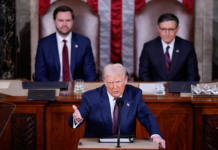
The European Union’s executive arm requested “full clarity” from the United States and asked its trade partner to fulfill its commitments after the U.S. Supreme Court struck down some of President Donald Trump’s most sweeping tariffs.
Trump has lashed out at the court decision and said Saturday that he wants a global tariff of 15%, up from the 10% he announced a day earlier.
The European Commission said the current situation is not conducive to delivering “fair, balanced, and mutually beneficial” trans-Atlantic trade and investment, as agreed to by both sides and spelled out in the EU-U.S. Joint Statement of August 2025.
American and EU officials sealed a trade deal last year that imposes a 15% import tax on 70% of European goods exported to the United States. The European Commission handles trade for the 27 EU member countries.
A top EU lawmaker said on Sunday he will propose to the European Parliament negotiating team to put the ratifying process of the deal on pause.
“Pure tariff chaos on the part of the U.S. administration,” Bernd Lange, the chair of Parliament’s international trade committee, wrote on social media. “No one can make sense of it anymore — only open questions and growing uncertainty for the EU and other U.S
The value of EU-U.S. trade in goods and services amounted to 1.7 trillion euros ($2 trillion) in 2024, or an average of 4.6 billion euros a day, according to EU statistics agency Eurostat.
“A deal is a deal,” the European Commission said. “As the United States’ largest trading partner, the EU expects the U.S. to honor its commitments set out in the Joint Statement — just as the EU stands by its commitments. EU products must continue to benefit from the most competitive treatment, with no increases in tariffs beyond the clear and all-inclusive ceiling previously agreed.”
Read Also: Trump Sues JPMorgan For $5Bn, Claims Account Was Blocked
Jamieson Greer, Trump’s top trade negotiator, said in a CBS News interview Sunday morning that the U.S. plans to stand by its trade deals and expects its partners to do the same.
He said he talked to his European counterpart this weekend and hasn’t heard anyone tell him the deal is off.
“The deals were not premised on whether or not the emergency tariff litigation would rise or fall,” Greer said. “I haven’t heard anyone yet come to me and say the deal’s off. They want to see how this plays out.”
Europe’s biggest exports to the U.S. are pharmaceuticals, cars, aircraft, chemicals, medical instruments, and wine and spirits. Among the biggest U.S. exports to the bloc are professional and scientific services like payment systems and cloud infrastructure, oil and gas, pharmaceuticals, medical equipment, aerospace products and cars.
“When applied unpredictably, tariffs are inherently disruptive, undermining confidence and stability across global markets and creating further uncertainty across international supply chains,” the commission added.
As primarily a trading bloc, the EU has a powerful tool at its disposal to retaliate — the bloc’s Anti-Coercion Instrument. It includes a raft of measures for blocking or restricting trade and investment from countries found to be putting undue pressure on EU member nations or corporations.
The measures could include curtailing the export and import of goods and services, barring countries or companies from EU public tenders, or limiting foreign direct investment. In its most severe form, it would essentially close off access to the EU’s 450-million customer market and inflict billions of dollars of losses on U.S. companies and the American economy.
President Donald Trump sued banking giant JPMorgan Chase and its CEO Jamie Dimon for $5 billion on Thursday over allegations that JPMorgan stopped providing banking services to him and his businesses for political reasons after he left office in January 2021.
The lawsuit, filed in Miami-Dade County court in Florida, alleges that JPMorgan abruptly closed multiple accounts in February 2021 with just 60 days notice and no explanation. By doing so, Trump claims JPMorgan and Dimon cut the president and his businesses off from millions of dollars, disrupted their operations and forced Trump and the businesses to urgently open bank accounts elsewhere.
“JPMC debanked (Trump and his businesses) because it believed that the political tide at the moment favored doing so,” the lawsuit alleges.
Read Also: Trump Blasts Supreme Court Ruling, Calls 10% Global Tariff
In the lawsuit, Trump alleges he tried to raise the issue personally with Dimon after the bank started to close his accounts, and that Dimon assured Trump he would figure out what was happening. The lawsuit alleges Dimon failed to follow up with Trump. Further, Trump’s lawyers allege that JPMorgan placed the president and his companies on a reputational “blacklist” that both JPMorgan and other banks use to keep clients from opening accounts with them in the future.
In a statement, JPMorgan said it believes the suit has no merit.
Trump threatened to sue JPMorgan Chase last week at a time of heightened tensions between the White House and Wall Street. The president said he wanted to cap interest rates on credit cards at 10% to help lower costs for consumers. Chase is one of the largest issuers of credit cards in the country and a bank official told reporters that it would fight any effort by the White House or Congress to implement a rate cap on credit cards. Bank industry executives have also bristled at Trump’s attacks on the independence of the Federal Reserve.
Debanking first became a national issue when conservatives accused the Obama administration of pressuring banks to stop extending services to gun stores and payday lenders under “Operation Choke Point.”
Trump and other conservative figures have alleged that banks cut them off from their accounts under the umbrella term of “reputational risk” after the Jan. 6, 2021, attack on the U.S. Capitol. Since Trump came back into office, the president’s banking regulators have moved to stop any banks from using “reputational risk” as a reason for denying service to customers.
“JPMC’s conduct … is a key indicator of a systemic, subversive industry practice that aims to coerce the public to shift and re-align their political views,” Trumps lawyers wrote in the lawsuit.
Trump accuses the bank of trade libel and accuses Dimon himself of violating Florida’s Unfair and Deceptive Trade Practices Act.