















|
Listen to article
|
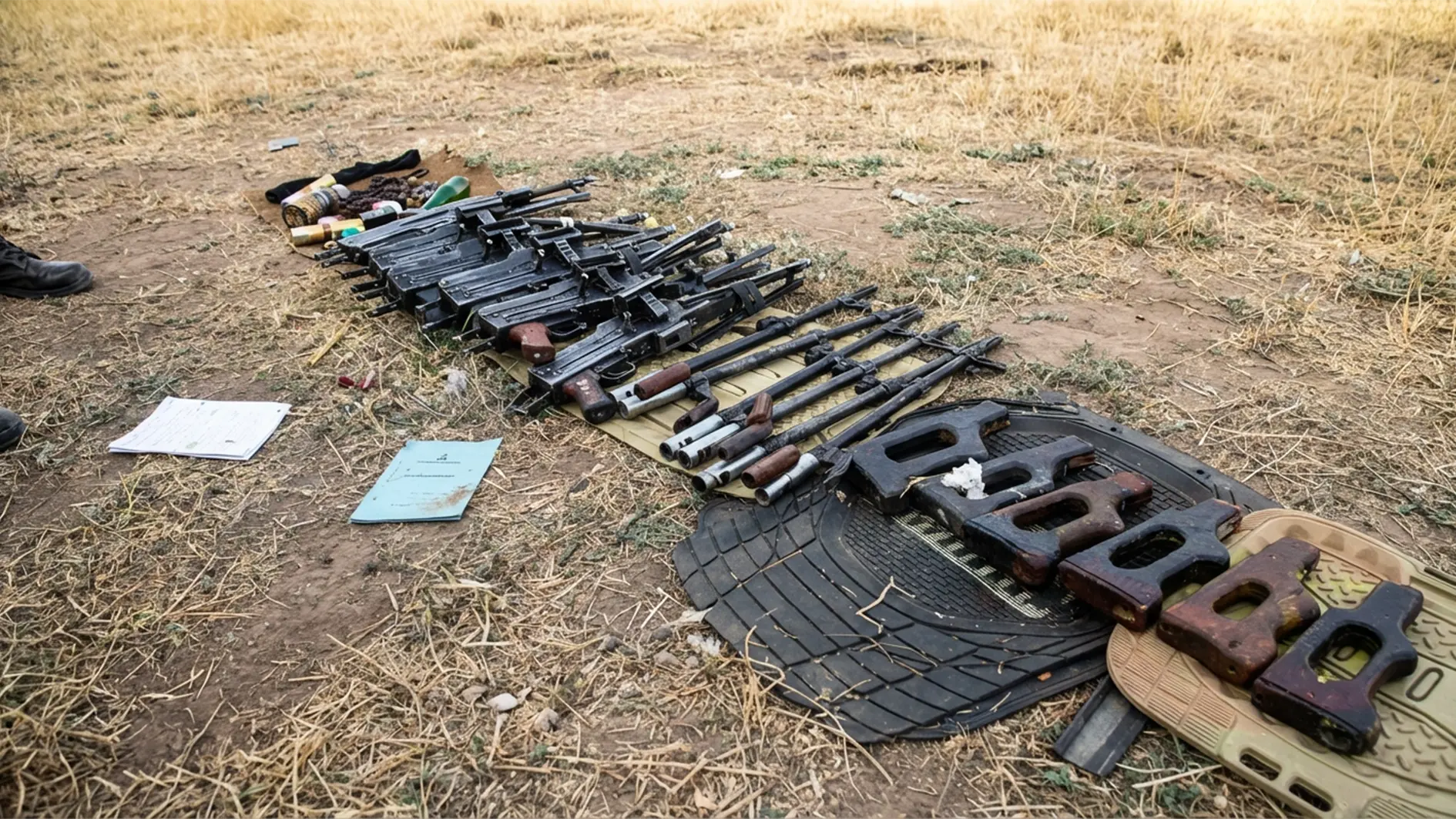
Troops of the 6 Brigade Nigerian Army operating under Sector 3 of Operation Whirl Stroke have arrested a suspected weapons trafficker in Ibi Local Government Area of Taraba State and recovered six PKT machine guns alongside ammunition, cash, and a vehicle in an intelligence-led operation that security officials described as a significant disruption to illegal arms circulation across the state.
The arrest took place on February 12, 2026, following credible intelligence that prompted troops deployed at the Forward Operating Base in Wukari to move swiftly against a suspected gunrunner operating within the area. The operation was announced publicly by the brigade through a statement signed by Acting Assistant Director of Army Public Relations Lieutenant Umar Muhammad on Saturday. The suspect, identified as Abubakar Ibrahim, 48, is a native of Barkin Ladi Local Government Area of Plateau State. His presence in Taraba, far from his home state, forms part of the investigation that security authorities said was ongoing as of the time of the announcement. Ibrahim is currently in military custody and has not yet been charged or arraigned before a civilian court.
A thorough search conducted on the suspect and his vehicle yielded a substantial cache of weapons and associated items. Items recovered from Ibrahim included six PKT machine guns, two rounds of 7.62mm special ammunition, a cash sum of 170,000 naira, one Peugeot 504 vehicle, one Q Seven mobile phone, seven bottles and wraps of perfume, and two small containers of Vaseline.
Read Also: Nigeria Divided Over US Troops As Aircraft Land In Borno
The six PKT machine guns recovered represent the most operationally significant element of the seizure. The PKT is a Soviet-era 7.62mm general-purpose machine gun originally designed for armored vehicle mounting but widely adapted for infantry use and extensively proliferated across conflict zones in sub-Saharan Africa. Their presence in civilian hands in Taraba State raises serious questions about the scale and sophistication of the arms supply network Ibrahim is alleged to have been serving.
The combination of weapons, perfume, and personal effects suggests the suspect may have been using commercial goods as cover for the movement of firearms, a tactic documented in multiple arms trafficking cases across Nigeria’s north-central and northeastern regions. Security analysts have noted that traffickers operating across state boundaries frequently embed weapons within legitimate cargo or personal effects to evade routine checkpoints.
Barkin Ladi, Ibrahim’s home local government area in Plateau State, has itself been a flashpoint for farmer-herder violence and community clashes in recent years, making it a location of persistent security concern. The cross-state nature of Ibrahim’s alleged trafficking operation, moving weapons from or through Plateau State into Taraba, reflects a broader pattern of arms flowing between conflict-affected communities in Nigeria’s Middle Belt. Taraba State, which shares boundaries with Adamawa, Benue, Nasarawa, Plateau, and Gombe states as well as an international border with Cameroon, has long been identified as a corridor for illegal weapons movement. The state’s diverse ethnic composition, rugged terrain across the Mambilla Plateau and Taraba River Basin, and history of communal violence create conditions that sustain demand for unlicensed firearms.
Operation Whirl Stroke, under which the 6 Brigade operates, was established to address security challenges across the North-Central region and has maintained forward operating bases at multiple locations to intercept criminal activity along key routes. The Wukari Forward Operating Base, from which the troops involved in Ibrahim’s arrest were deployed, sits in the southern part of Taraba State close to the Benue State boundary, a zone of heightened security activity.
Read Also: US Troops in Nigeria Won’t Fight Bandits, Ex-General Says
Brigade Commander Brigadier General Chukwuemeka Michael Akaliro commended the troops involved in the operation, crediting their vigilance and professional conduct for the successful interception. He urged the troops to sustain the operational tempo in line with the mandate assigned by the Chief of Army Staff. Akaliro also acknowledged the critical role played by local residents in providing the intelligence that made the operation possible. “He also appreciated the cooperation of local residents who provided timely and credible intelligence that significantly supported the success of the operation,” Lieutenant Muhammad said in the brigade’s statement.
The commander called on members of the public to remain alert to suspicious activity and continue providing actionable information to security agencies, framing community intelligence as an essential component of the military’s ability to detect and disrupt criminal operations before they cause harm.
“The Brigade remains resolute in its mandate to protect lives and property, and to restore lasting peace and stability across Taraba State,” Akaliro stated.
No further details were disclosed regarding how Ibrahim came to be in possession of the six PKT machine guns, the origin of the weapons, their intended destination, or whether other individuals are sought in connection with the suspected trafficking operation. The army’s statement indicated that investigations were continuing. The absence of information on a potential buyer network or the route through which the weapons were moving limits public understanding of the operation’s broader significance, though military officials typically withhold such details during active investigations to avoid compromising ongoing intelligence work.
Ibrahim’s arraignment timeline before a court of competent jurisdiction has not been announced. Under Nigerian law, military operatives who make arrests are required to transfer suspects to police custody for prosecution through the civilian judicial system unless the matter relates to a purely military offense.