


















|
Listen to article
|
Nigeria’s Senate reversed itself Tuesday on a controversial decision that had sparked nationwide protests, voting to permit electronic transmission of election results after initially rejecting the provision last week, though the revised amendment stops short of making the technology mandatory and includes fallback provisions that critics say preserve loopholes for manipulation.
The upper chamber rescinded its February 4 decision during a rowdy emergency session marked by procedural confusion, shouting matches between lawmakers, and brief threats of an individual vote that could have derailed the reversal. Senate Chief Whip Tahir Monguno moved the motion citing “fresh issues” that emerged from closer scrutiny of the bill and overwhelming public backlash against the chamber’s original position, which had retained discretionary “transfer” language instead of requiring real-time electronic “transmission” of polling unit results to the Independent National Electoral Commission’s Result Viewing portal.
“This amendment is to bring our laws to make it a replica of the wishes and aspirations of the people,” Monguno said.
Minority Leader Abba Moro seconded the motion, describing the development as “the beauty of democracy” and noting that lawmakers must retain courage to correct themselves when necessary. Senate President Godswill Akpabio put the motion to a voice vote, which passed with majority support despite audible dissent from some corners of the chamber. The reversal came exactly one week after the Senate had passed the Electoral Act Amendment Bill rejecting mandatory real-time electronic transmission—a decision that triggered protests at the National Assembly gates Monday, condemnation from the Nigeria Labour Congress threatening election boycotts, and accusations from opposition parties and civil society that lawmakers were deliberately creating conditions for electoral fraud ahead of 2027 voting.
Under the revised provision approved Tuesday, presiding officers at polling units shall electronically transmit results to INEC’s portal after completing and signing Form EC8A, the official tally sheet countersigned by party agents. However, the amendment includes a critical caveat: where electronic transmission fails due to network or communication challenges, the manually completed and signed EC8A form will serve as the primary source for result collation and declaration. Critics immediately seized on this language, arguing it provides INEC with the same discretion to avoid electronic transmission that plagued the disputed 2023 presidential election, when the commission failed to upload results as anticipated despite spending billions of naira on the technology and promising voters it would function seamlessly. The provision does not make electronic transmission mandatory in the sense of requiring it under all circumstances or imposing penalties for non-compliance. Instead, it establishes electronic transmission as the default method while explicitly authorizing manual processes when technical problems occur, a framework opposition figures and electoral reform advocates say leaves room for the same failures and manipulation that have undermined confidence in Nigerian elections for decades.
Read Also: Ningi Says Senate Can Openly Vote On Results E-Transmission
Trouble erupted when Monguno rose to invoke Senate Standing Orders 1(b) and 52(6) shortly after Akpabio began reading pages of the votes and proceedings from the February 4 session, seeking leave to rescind the chamber’s earlier resolution on the disputed Clause 60(3). His request immediately triggered confusion, with several senators questioning whether such a motion could be entertained while consideration of the votes and proceedings was still ongoing and others arguing the invocation gave the Senate latitude to suspend normal procedure.
Shouting broke out as lawmakers debated procedural questions, with some demanding clarity on what exactly was being proposed and whether the reversal would genuinely mandate electronic transmission or merely create another ambiguous provision subject to competing interpretations.
Senator Eyinnaya Abaribe raised a point of order calling for individual voting by senators rather than a voice vote, citing Senate rules on division when outcomes appear contested. The move threatened to slow proceedings and expose individual senators’ positions on the record, potentially embarrassing for those who had publicly defended the February 4 decision as preserving electronic transmission despite language suggesting otherwise. Abaribe withdrew the point of order minutes later amid concerns it could stall the amendment process and prevent the Senate from addressing the controversy before public anger intensified further.
Monguno explained the confusion arose from controversy between use of the words “transfer” and “transmission” of election results, insisting clarity was required to eliminate ambiguity and restore public confidence shattered by the Senate’s initial handling of the amendment. He argued the fresh language would resolve doubts while acknowledging technical realities that could prevent transmission in areas with poor connectivity, a rationale that mirrors Senate President Akpabio’s defense last week when he insisted electronic transmission was retained despite removal of “real-time” from the bill’s text. That explanation satisfied few critics, who noted that discretionary provisions have historically enabled electoral fraud during manual collation processes where results are altered between polling units and central tallying centers.
Read Also: Senate President Explains Stance On Digital Vote Transmission
The Senate effectively acknowledged Tuesday that its February 4 version was passed without adequate provision for electronic transmission, a remarkable admission given Akpabio and other leaders had spent days insisting no such rejection occurred and that social media criticism misrepresented what lawmakers actually approved.
Several senators, including Abaribe, Aminu Tambuwal, and Natasha Akpoti-Uduaghan, had held a press conference last Thursday claiming the Senate leadership misrepresented what was voted on during the February 4 session and that announced outcomes differed from actual vote counts, charges Akpabio never directly addressed but which Tuesday’s reversal implicitly validates.
The Nigeria Labour Congress had threatened mass action or total election boycotts if the Senate did not mandate real-time electronic transmission, warning that ambiguity at such a critical moment, barely 16 months before 2027 general elections, risks institutionalizing doubt at the heart of Nigeria’s electoral system.
NLC President Joe Ajaero said organized labor would not stand by while trust is betrayed and electoral laws compromised, calling for crystal-clear provisions leaving no room for INEC to avoid transparency measures. Thousands of protesters gathered at the National Assembly Monday demanding lawmakers reverse course, with police using tear gas and pepper spray to prevent demonstrators from entering the legislative complex as they chanted “Our votes must count” and “No to electoral robbery.”
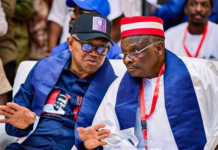
Opposition presidential candidate Peter Obi of the African Democratic Congress joined Monday’s protests, telling crowds that “simple transmission is not a difficult thing” and urging the Senate to allow elections to proceed transparently without artificial obstacles. Former Vice President Atiku Abubakar of the Peoples Democratic Party had called the Senate’s February 4 decision “a grave setback for electoral reform” and “a calculated blow against transparency,” arguing that real-time electronic transmission reduces human interference and limits result manipulation. The Nigerian Guild of Editors warned current uncertainty creates room for doubt and urged harmonization with the House of Representatives, which passed a version explicitly requiring real-time transmission without the Senate’s conditional language.
The Senate appointed 12 members to a conference committee that will harmonize differences with the House version before the bill proceeds to President Bola Tinubu for signature. The new chairman of the reconstituted committee is Simon Bako Lalong, former governor of Plateau State. Whether the final legislation will include stronger mandatory language or preserve the Senate’s conditional framework remains uncertain and will depend on negotiations between the two chambers in coming weeks. Civil society organizations have urged the conference committee to adopt unambiguous provisions explicitly mandating real-time electronic transmission and collation of results, warning that half-measures will perpetuate the cycle of disputed elections that has undermined democracy and triggered constitutional crises.
INEC has postponed release of the timetable for 2027 general elections pending completion of the Electoral Act amendments, saying it cannot finalize schedules while fundamental rules governing the vote remain under revision.