














|
Listen to article
|
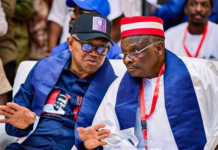
Abia State Governor, Dr. Alex Otti, has ruled out any possibility of the Labour Party entering into a coalition ahead of Nigeria’s 2027 general elections, insisting that the party already represents a broad alliance of interests rooted in workers’ movements and progressive politics.
Speaking to journalists in Abuja on Saturday after a meeting of the Labour Party’s National Executive Committee, Otti dismissed ongoing speculations about merger talks or coalition arrangements with other political parties. According to him, such conversations misunderstand the ideological foundation of the Labour Party and its political identity.
“The Labour Party is already a coalition,” Otti said. “It is a coalition of Nigerian workers and people of progressive minds who believe in fairness, equity, and responsible governance. So, when people talk about joining another coalition, we have no such plans.”
His comments come amid heightened political maneuvering across party lines, as major political actors quietly begin positioning themselves for the 2027 polls. In recent months, there has been growing public debate about the possibility of opposition parties forming broad alliances to challenge the ruling party, particularly after the 2023 elections exposed both the strengths and limitations of fragmented opposition politics.
Read also: Alex Otti Government House Dispute Sparks Legal Threat
Otti’s position appears to signal a strategic decision by the Labour Party to consolidate internally rather than dilute its platform through external partnerships. Party insiders say the leadership believes its surge in popularity in the last election cycle was driven by a clear ideological message that resonated with urban voters, young people, and organised labour, rather than by traditional elite-driven coalitions.
The NEC meeting itself was held against the backdrop of a major leadership shake up within the party. Only days earlier, the Federal High Court in Abuja affirmed the removal of Julius Abure as the national chairman of the Labour Party. In its ruling, the court also ordered the Independent National Electoral Commission to recognise a National Caretaker Committee led by former senator Nenadi Usman as the party’s lawful leadership.
Governor Otti confirmed during his interaction with journalists that INEC had complied with the court’s directive. He said the electoral body had already removed Abure’s name from its official records and replaced it with that of Usman, a development that effectively cements the caretaker committee’s authority, at least for now.
“Yes, INEC has obeyed the court order,” Otti said. “The name of the former chairman has been taken down, and the name of Senator Nenadi Usman has been uploaded. That tells you that the process of restoring order within the party has begun.”
The court ruling and INEC’s subsequent action mark a significant moment for the Labour Party, which has been grappling with internal disputes since its unexpected electoral breakthrough in 2023. While the party gained national visibility and secured key victories, including Otti’s win in Abia State, internal disagreements over leadership structure, candidate selection, and control of party machinery have persisted.
Supporters of the caretaker committee argue that the changes are necessary to stabilise the party and prepare it for future elections. They say unresolved leadership battles would weaken the party’s credibility and distract from its policy agenda, especially at a time when public dissatisfaction with governance remains high across the country.
Read also: Gov Otti Says Taxation Must Drive Growth, Not Punish Citizens
However, Julius Abure has rejected the court’s ruling, describing it as unacceptable and legally flawed. He has vowed to challenge the decision at the Court of Appeal, setting the stage for a prolonged legal battle that could further test the party’s internal cohesion. Abure maintains that he remains the legitimate national chairman and that the court decision does not reflect the true position of the law.
Political analysts say the unfolding situation presents both risks and opportunities for the Labour Party. On one hand, the leadership crisis could erode public confidence if it drags on unresolved. On the other, a clear and widely accepted leadership structure could strengthen the party’s organisational capacity and allow it to focus on policy articulation and grassroots expansion.
Governor Otti’s firm stance against coalition politics may also shape the party’s strategic direction in the coming years. By framing the Labour Party as a self sufficient coalition of workers and progressives, he appears to be drawing a sharp contrast with Nigeria’s dominant political culture, which often relies on last minute alliances driven more by power calculations than shared ideology.
Observers note that this position could appeal to voters disillusioned with what they see as transactional politics, while also posing challenges in a system where electoral success often depends on broad regional and elite networks. Whether the Labour Party can translate its ideological clarity into nationwide electoral strength remains an open question.
For now, Otti insists that the party’s focus should be on internal unity, policy development, and delivering good governance where it holds power. He pointed to his administration in Abia State as an example of what the party represents in practice, arguing that performance in office would ultimately be its strongest campaign message ahead of 2027.