














|
Listen to article
|
Fact-Check 62 — The Statistics That Disagree
A Celebration Built on Sand
When Governor Hope Uzodinma stood before cameras on January 24, 2025, proclaiming that Imo had “completely eliminated out-of-school children,” the applause was thunderous. The event, lavishly staged at Heroes Square, was meant to symbolize triumph over educational exclusion. State-run broadcasters looped footage of smiling pupils, and local dignitaries hailed the governor as “the architect of universal learning.”
But numbers do not clap. They measure, they record, and they remember. Beneath the banners of “Education for All,” the data tells a quieter, more sobering truth — that tens of thousands of Imo’s children still wake each morning without the hope of a classroom.
The Numbers Behind the Illusion
According to the National Bureau of Statistics (2024), Imo State still records 68,400 out-of-school children, roughly 5.8 percent of its school-age population. The Federal Ministry of Education’s National Enrollment Survey (2024) confirms this figure, ranking Imo among the middle-tier states for access to basic education.
The UNICEF Nigeria Education Fact Sheet (2024) corroborates it: “Imo State continues to show moderate improvement in enrollment but persistent exclusion in rural LGAs, especially among girls.” Even the Imo State Universal Basic Education Board (SUBEB) admitted in its own 2024 report that “attendance gaps remain significant in Ohaji-Egbema, Ngor Okpala, and Ihitte-Uboma.”
Zero, then, is not a statistic — it is a slogan.
The Geography of Exclusion
In Aboh Mbaise, classrooms with cracked walls hold half the pupils listed on official rosters. In Ngor Okpala, children still hawk groundnuts during school hours. Head teachers privately admit that enrollment lists are sometimes inflated before government audits — a bureaucratic performance designed to satisfy targets, not truth.
The Nigeria Governors’ Forum (2024) Education Scorecard, an independent benchmark, ranks Imo 12th in access and 17th in retention. The state’s rural-urban divide remains stark: urban attendance averages 94 percent, while in rural belts it drops below 70 percent.
Numbers that fluctuate like these cannot sustain a declaration of universality. They only confirm uneven progress disguised as perfection.
Budgets Without Classrooms
In a state where 133 million Nigerians nationwide live in multidimensional poverty, education is not just policy — it is survival. Yet, the BudgIT Foundation (2025) found that only ₦5.8 billion of Imo’s ₦13.2 billion education allocation was released in 2024.
With classrooms in disrepair and teachers unpaid, the burden shifts to parents. The Nigeria Union of Teachers (2024) audit reported that nearly 30 percent of public schools in Imo operate with fewer than two qualified teachers.
This is the arithmetic of failure: underfunded systems yield undereducated generations. You cannot legislate children into classrooms when infrastructure, staffing, and poverty erect invisible gates around every village.
Policy Without Practice
To declare “zero out-of-school children” is to claim success on three fronts: enrollment, attendance, and completion. The Federal Ministry of Education sets those as the metrics for universal basic education. Imo fails all three.
- Enrollment remains incomplete.
- Attendance fluctuates in low-income LGAs.
- Completion rates stagnate at 74 percent, far below the national target of 85 percent.
The African Development Bank (2024) summarized it with surgical precision: “Political declarations of progress have outpaced empirical accountability.” The governor’s announcement fits that pattern — rhetoric unmoored from evidence.
The Human Face of Statistics
Every data point conceals a story. In Ohaji-Egbema, a 13-year-old boy named Chibuike spends his mornings crushing stones for N1,000 a day. His father tells reporters: “School is for those who can afford to be hungry.” In Obowo, community teachers teach two shifts to compensate for colleagues who have abandoned their posts due to months of unpaid allowances.
UNICEF’s 2024 study warns that Imo’s dropout rate among girls aged 10–14 is rising due to “economic pressures and cultural constraints.” These are not numbers on a chart — they are lives suspended between deprivation and neglect.
If the government truly reached every child, these stories would not still multiply.
The Politics of Perception
Political storytelling in Imo has perfected the art of absolutes — zero poverty, zero insecurity, zero exclusion. The word “zero” has become less a statistic than a slogan, polished for applause and projection. It functions not as evidence but as spectacle, a way to frame governance as triumph rather than process.
At the ceremony where the declaration was made, no data accompanied the claim. Questions about enrollment figures and attendance rates were deflected, replaced with the familiar refrain of “work in progress.” Weeks later, officials promised that “records are being reviewed,” a phrase now synonymous with silence.
What emerges is a pattern in which perception outruns proof. The state prefers performance to disclosure, slogans to statistics. In this theater of governance, transparency is treated as a threat to narrative control. Numbers are guarded not because they are secret, but because they reveal too much.
True accountability requires more than public relations. It begins with the courage to tell the truth even when it contradicts the script of success. Until that happens, “zero” will remain not a measure of progress, but a monument to illusion.
A Hollow Declaration
Imo has made progress, but progress is not perfection. Between 2021 and 2024, enrollment rose by nearly 11 percent, driven by local campaigns and federal grants. Yet the claim of total success is not only misleading — it robs genuine reform of credibility.
Governance rooted in illusion cannot sustain reform. The Nigeria Governors’ Forum cautioned that “false metrics distort planning and weaken accountability.” When leaders confuse aspiration for accomplishment, public trust becomes the first casualty.
The National Population Commission (2024) estimates that by 2030, Imo will add 150,000 more school-age children. If today’s system cannot accommodate 68,000, what will tomorrow’s look like?
The Moral Cost of a Lie
Education is the social contract between state and citizen — the first promise a government owes its people. To falsify progress in this sector is not a minor exaggeration; it is a betrayal.
Read also: Falsehood No. 61 — “Imo Now Exports Agricultural Produce To Europe”
Behind every falsified statistic is a child condemned to ignorance. Behind every press release is a parent who believed the promise and stopped demanding better. The UNDP (2024) warned that “states that distort educational data risk entrenching a culture of managed decline.” That phrase defines Imo’s current predicament — a decline disguised as reform.
Chart 1: Out-of-School Children – Reality vs Political Claim
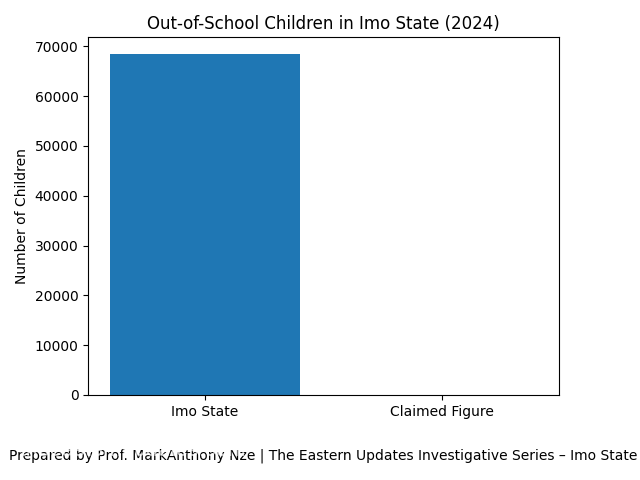
This chart directly contrasts the governor’s declaration of zero out-of-school children with verified national data. While the official claim asserts total elimination, the National Bureau of Statistics and the Federal Ministry of Education record approximately 68,400 out-of-school children in Imo State in 2024. The visual gap between zero and the verified figure highlights the scale of exaggeration. Rather than marginal error, this is a fundamental misrepresentation of reality. The chart demonstrates that educational exclusion in Imo remains substantial and measurable, disproving the claim of universality and reinforcing the need for policy grounded in evidence rather than rhetoric.
Chart 2: School Attendance Gap – Urban vs Rural LGAs
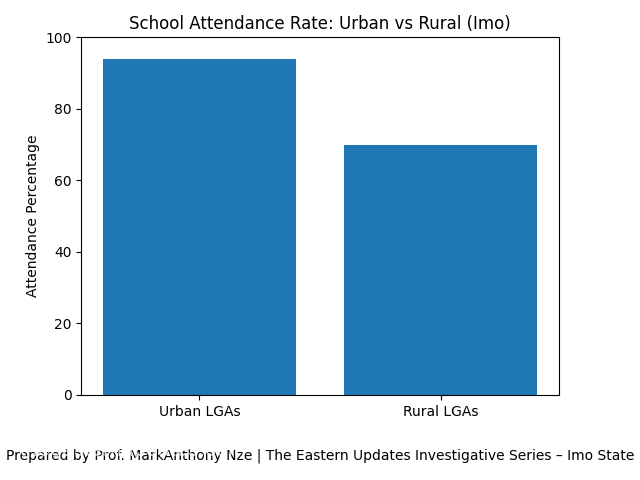
This chart exposes the structural inequality behind the “zero exclusion” narrative. Urban LGAs in Imo record average attendance rates of about 94%, while rural LGAs fall below 70%, according to NBS and UNICEF data. The disparity reveals that access to education is uneven and geographically determined. Rural poverty, child labour, poor infrastructure, and teacher shortages continue to push children out of school. A state with such an attendance gap cannot plausibly claim universal enrollment. The chart underscores that progress in urban centers is being used to mask persistent rural educational deprivation.
Chart 3: Education Budget – Allocation vs Actual Release
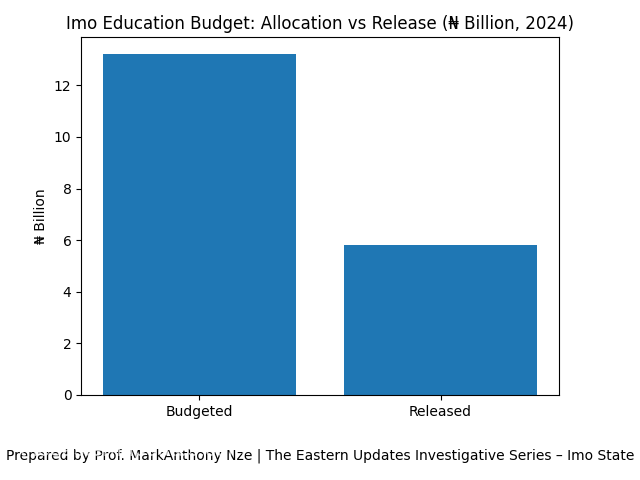
This chart shows why exclusion persists. In 2024, Imo State budgeted ₦13.2 billion for education, but only ₦5.8 billion was released, meaning more than half of approved funding never reached the sector. This under-release translates into dilapidated classrooms, unpaid teachers, and limited outreach to vulnerable children. The chart makes clear that educational failure is not accidental—it is fiscally engineered. Declaring “zero out-of-school children” while withholding funds exposes a contradiction between political messaging and financial commitment.
Chart 4: Universal Basic Education Indicators
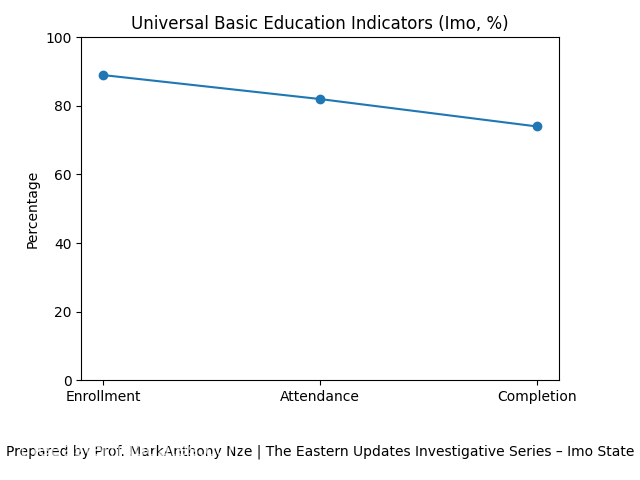
This chart assesses education using federal benchmarks: enrollment (89%), attendance (82%), and completion (74%). True universality requires all three to approach 100%. Instead, Imo falls well below national targets, especially in completion rates. Children may enroll, but many do not stay or finish. The chart demonstrates that educational access in Imo is fragile, inconsistent, and incomplete. It decisively disproves the claim of total success and shows that reform remains unfinished, uneven, and overstated.
Verdict — The Arithmetic of Deception
Governor Uzodinma’s claim of “zero out-of-school children” does not survive contact with data, observation, or conscience.
The numbers disagree. The schools disagree. The children outside classrooms disagree.
Progress has been made, yes — but propaganda has been made louder. Education reform cannot be declared into existence. It must be built, funded, and verified. Until that happens, the promise of universal education remains another political phrase in the language of illusion.
Imo’s equation, like its policy, does not balance. In the calculus of governance, zero truth is worse than zero achievement.
Professor MarkAnthony Ujunwa Nze is an internationally acclaimed investigative journalist, public intellectual, and global governance analyst whose work shapes contemporary thinking at the intersection of health and social care management, media, law, and policy. Renowned for his incisive commentary and structural insight, he brings rigorous scholarship to questions of justice, power, and institutional integrity.
Based in New York, he serves as a full tenured professor and Academic Director at the New York Center for Advanced Research (NYCAR), where he leads high-impact research in governance innovation, strategic leadership, and geopolitical risk. He also oversees NYCAR’s free Health & Social Care professional certification programs, accessible worldwide at:
👉 https://www.newyorkresearch.org/professional-certification/
Professor Nze remains a defining voice in advancing ethical leadership and democratic accountability across global systems.
Bibliographies
African Development Bank. (2024). Nigeria Human Capital and Education Quality Review 2024. Abidjan: AfDB Human Development Department.
BudgIT Foundation. (2025). State of States Report 2025 – Education Financing and Learning Outcomes (Imo Chapter). Lagos: BudgIT Foundation.
Federal Ministry of Education. (2024). National School Enrollment and Out-of-School Children Survey 2024. Abuja: EMIS Department.
Imo Broadcasting Corporation (IBC TV). (2025, January 24). Governor Uzodinma Declares Zero Out-of-School Children in Imo. Owerri: IBC Archives.
Imo State Government. (2025, January 25). Press Release: Governor Uzodinma’s Speech on International Education Day – “Every Child in School.” Owerri: Ministry of Information and Strategy.
Imo State Ministry of Education. (2024). Annual Education Sector Performance Report 2024. Owerri: Department of Planning, Research & Statistics.
Imo State Universal Basic Education Board (SUBEB). (2024). School Enrollment and Attendance Register Audit Report 2024. Owerri: SUBEB Data Unit.
National Bureau of Statistics. (2024). Multiple Indicator Cluster Survey (MICS) 2024 – Education Indicators by State. Abuja: NBS.
National Population Commission. (2024). Children in Education and Labour Force Participation Survey 2024. Abuja: NPC.
Nigeria Governors’ Forum. (2024). Subnational Education Scorecard 2024 – Access and Retention Rates. Abuja: NGF Secretariat.
Nigeria Union of Teachers. (2024). State-Level Teaching and Enrollment Audit 2024. Abuja: NUT Policy Unit.
Premium Times Nigeria. (2025, February 3). Fact-Check: Imo Did Not Achieve Zero Out-of-School Children – NBS Data Shows Otherwise. Retrieved from https://www.premiumtimesng.com
Punch Newspapers. (2025, February 5). Rural Pupils Still Out of School Despite Governor’s Claim of Universal Access. Retrieved from https://punchng.com
The Guardian Nigeria. (2025, February 7). Education Gap Widens in Imo Villages Despite “Zero Out-of-School” Claim. Retrieved from https://guardian.ng
United Nations Children’s Fund (UNICEF). (2024). Nigeria Education Fact Sheet 2024 – Out-of-School Children Estimates. Abuja: UNICEF Nigeria Country Office.