














|
Listen to article
|
The State Department warned Monday of a threat to US facilities and schools in Nigeria, urging Americans to take precautions.
“The US embassy in Abuja informs US citizens of a possible terrorist threat against US facilities and US affiliated schools in Nigeria,” it said in a notice.
“Increasing awareness of your surroundings, avoiding predictable routines, and reviewing general security precautions with your family can help reduce your risk,” it said.
The embassy did not spell out the source of the threat.
Read Also: Iran Threatens Diaspora With Asset Seizures For Pro-US Posts
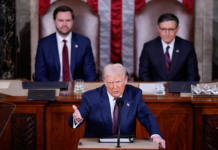
President Donald Trump on Christmas Day ordered US bombings of Nigeria, saying he was targeting jihadists.
The attack came after Trump complained that Christians were facing persecution in Africa’s most populous nation, an assessment that is contested in a country that has seen wide violence against both Christians and Muslims.
The warning in Nigeria also comes amid a global security warning by the United States after Washington and Israel attacked Iran, which has responded with missile and drone attacks against its US-aligned neighbors.
Iran’s prosecutor general’s office threatened on Monday to seize all property belonging to diaspora Iranians who expressed support for the United States and Israel, the most sweeping legal threat ever directed at Iranian nationals abroad, and one that arrived against a backdrop of mass celebratory rallies in dozens of countries where Iranians had gathered to mark the killing of Supreme Leader Ali Khamenei and call for regime change in Tehran.
“Iranians abroad who align, accompany and cooperate with the American-Zionist aggressor enemy will face confiscation of all their property and other legal penalties in accordance with the law,” the judiciary’s Mizan Online website said, quoting the prosecutor general’s office.
The threat explicitly covered Iranians who sympathised with, supported, or cooperated with what Tehran called “the American-Zionist enemy” — language broad enough to encompass social media posts, attendance at rallies, financial donations to opposition groups, and any form of public celebration of the war’s progress. The prosecutor general’s office did not specify a mechanism for identifying targeted individuals, though newly established Telegram channels had already begun circulating the names and personal details of prominent Iranians abroad who had posted comments critical of the Islamic Republic, compiling dossiers that Iranian diaspora rights groups described as hit lists.
Read Also: New Iran Leader Won’t Last Long Without My Approval – Trump
The threat invoked legislation passed after Iran’s twelve-day war with Israel in June 2025, which introduced asset confiscation as a penalty for cooperation with foreign enemies, a law rushed through Iran’s parliament at the time as a deterrence measure and now being deployed at far greater scale against a diaspora that had responded to the February 28 strikes with open celebration.
Celebratory rallies against the Islamic Republic were held worldwide after the start of the Iran war on February 28, led by the Iranian diaspora, where Iranians gathered waving anti-Islamic Republic symbols including the Lion and Sun flag.
The scale of those celebrations was unprecedented in the history of the diaspora: a rally in Toronto was reported to have 150,000 in attendance with zero incidents according to Toronto police. Demonstrations were held in Canada, the United States, the United Kingdom, Norway, Sweden, Finland, Denmark, Germany, the Netherlands, Belgium, France, Switzerland, Portugal, Spain, Austria, Hungary, Italy, Poland, Slovenia, Bulgaria, Greece, Cyprus, Romania, Ukraine, Turkey, Ghana, Israel, Georgia, Armenia, India, South Korea, Japan, Australia, New Zealand, and Chile.
The Iranian government was simultaneously monitoring diaspora activity through a sophisticated social media surveillance operation. Newly created Telegram channels were compiling and publishing the personal details, names, photographs, cities of residence, employers, and family connections — of prominent Iranians abroad who had posted comments supportive of the US-Israeli campaign, creating public exposure documents that security researchers described as designed to enable physical targeting by IRGC-linked cells operating abroad.
The threat of IRGC extraterritorial violence against diaspora dissidents was not hypothetical: in March 2025, Iran International journalist Pouria Zeraati was stabbed outside his London home following months of threats against the station’s journalists, and British counterterrorism police arrested four people suspected of spying on Jewish communities in London for the Islamic Republic on March 6, 2026 — the same day a federal jury in Brooklyn convicted Pakistani-Iranian operative Asif Merchant of a murder-for-hire plot targeting US politicians. Foreign security officials warned following the February 28 strikes that Iranian sleeper cells abroad had been activated.
In Moscow, police detained members of the diaspora who celebrated the death of Khamenei. In Birmingham, England, clashes broke out between Islamic Republic supporters and diaspora counter-protesters.
In Washington Square Park in Manhattan on March 6, clashes between Khamenei supporters and diaspora counter-protesters resulted in multiple NYPD arrests.
The polarised environment in Western cities reflected a diaspora that was not monolithic, a significant proportion of Iranians abroad, particularly those who had left before 1979 or maintained Islamic Republic connections, opposed the war and mourned Khamenei’s killing, while the majority who had fled the clerical state celebrated it.