











|
Listen to article
|
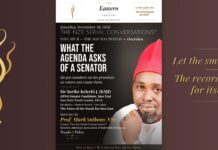
The Nze Serial Conversations™ ·
◆ Volume II takes the agenda he would carry to Abuja and tests each promise for the power, the money and the proof it would need. ◆

Interview, research and editorial direction
Creator, The Nze Serial Conversations™
Member, American Association of University Professors
Ask the question that matters. Let the answer run its course.
Keep every word on the record, in the speaker’s own voice.
Creator, NZE Forensic Serial Journalism Method™

APGA Candidate for the Senate, Imo East, and Imo State Youth Leader, All Progressives Grand Alliance
About This Series
The Nze Serial Conversations™ puts one question to its subject in each part and prints the answer in full, with analysis drawn from the public record. Volume I traced Sir Soribe Kelechi J. (KSJI) from a teachers’ household in Emekuku to the coordinator’s desk of two Senate campaigns. The agenda he would carry to the Senate for Imo East is the subject of Volume II. Each part takes one pledge, puts a hard question to him and tests his answer against the Constitution and the federal budget. One installment appears each day.
In the agenda he supplied to the press in October, Sir Soribe Kelechi J. (KSJI) put numbers on his central promises (Africa Today News, New York, 2026d). It names 500 scholarships, a liaison office in each of the nine councils of Imo East, a town hall every quarter and half of all constituency opportunities for young people and women. Figures give voters a way to keep score, and he put his in writing long before polling day.
Volume I asked where those promises came from. It followed him through a teachers’ household, five student offices, four council contests and two decades of campaign work, all under one party card (Volume I, Overview). This volume asks how the promises would work, and it makes the case that, on the evidence of his own agenda, he is the candidate best prepared to turn them into federal law and federal money for Imo East.
Promises Already in Print
The Emekuku Political File printed the agenda on November 1 and sorted the pledges that need federal partners from those that depend on him alone (Africa Today News, New York, 2026d). That reading stands. These Conversations take the next step and put each pledge to the man who made it, with a hard question attached.
Five parts follow. Each begins with the record, sets one question before him and prints his answer in full. An analysis then tests the answer against the Constitution, the federal budget and the programs earlier governments have run for the same voters.
The Test Every Pledge Must Pass
A pledge earns belief only when a power stands behind it. Senators make laws with the National Assembly, vote on the annual budget and may join inquiries into any federal ministry or agency (Constitution of the Federal Republic of Nigeria, 1999, ss. 4, 80, 81, 88). Section 58 sets the road every bill must travel: passage in both houses, then the President’s assent within thirty days, or a two-thirds vote in each house to pass it over his refusal. Any pledge that needs a power outside that list is a wish, whatever its merits.
It also needs money, and the Constitution guards the purse closely. Beyond the few charges the Constitution itself fixes, no money leaves the Consolidated Revenue Fund of the Federation without an Act of the National Assembly, and no other public fund of the Federation may be drawn on without one either (Constitution of the Federal Republic of Nigeria, 1999, s. 80). Every naira behind a federal pledge passes through the chamber he seeks to enter. For a senator who studies the estimates, that rule is an opening.
Voters can supply the last check themselves, and his agenda gives them the means: an annual public account of constituency spending, quarterly town halls and an open telephone line (Africa Today News, New York, 2026d). A voter in Ngor Okpala or Ahiazu Mbaise could check each year whether the scholarships went out, and to whom.

The Nze Serial Conversations™ · Frontispiece II. The Agenda and the Senate’s Powers
The Agenda Across Two Volumes
His agenda names eight concerns: youth employment, a stronger voice for the zone in federal appointments, rural infrastructure, education, security, agriculture, women’s empowerment and accountable representation (Africa Today News, New York, 2026d). This volume takes the pledges he has already tied to figures and to his own spending, the ones that touch jobs, schools, market women and the public account. Appointments, roads, security and farming belong to Volume III, where the Senate’s powers of confirmation, oversight and appropriation come into full view.
Read also: Campaigns Carried For Others: Sir Soribe — Part 5 Of 15
When Programs End
Imo East has heard federal promises to the young before. In July 2020 the federal cabinet approved a ₦75 billion Nigerian Youth Investment Fund for people aged 18 to 35 (Nairametrics, 2020). Two years earlier, TraderMoni lent petty traders ₦10,000 each, free of collateral and interest, with ₦15,000 for those who repaid (State House Nigeria, 2018).
Both were decisions of the executive. A program created by one administration can be renamed, cut or left unfunded by the next, and its intended beneficiaries have no law to point to. Funds established by an Act of the National Assembly stand until another Act changes them. The Tertiary Education Trust Fund, created by statute in 2011, still finances the federal institutions of this zone fifteen years on.
Sir Soribe has chosen the statute. His National Youth Enterprise and Skills Trust Fund Bill would write support for young entrepreneurs and apprentices into federal law, beyond the reach of a change in government. Part 8 asks him how the fund would be financed and governed, and how a senator outside the ruling party would carry it through both houses.
A Record Paid for Privately
His promises have a private history. For more than a decade he has covered school-leaving examination fees for Emekuku families who could not, and he has helped many of their children into FUTO, Imo State University and the two polytechnics (Africa Today News, New York, 2026d). Women in petty trade have received his support in sums of ₦20,000 to ₦100,000.
Those sums came from his own pocket. Money of that kind passes through no appropriation and answers to no auditor. It shows something a budget cannot, which is what a man does with resources nobody required him to share.
Set against federal practice, the figures hold up well. The smallest support he has extended to a trader doubles TraderMoni’s first loan, and the largest is ten times its size. Parts 6, 7 and 10 ask what that private record has taught him, and how its reach could grow from one town to nine councils.
What I did for one town with my own money, the law can do for nine councils.Sir Soribe Kelechi J. (KSJI), in Part 7 of this series
Sixteen Town Halls and Four Accounts
Accountability pledges are easy to make and easy to forget, so it helps to count them across a term. A senator serves four years before the Senate stands dissolved (Constitution of the Federal Republic of Nigeria, 1999, s. 64). Quarterly town halls over that span come to at least sixteen public meetings, and the annual account of constituency spending comes to four published reports. Nine liaison offices would stay open between them, one in every council from Owerri Municipal to Ezinihitte Mbaise.
Each of those figures is a date a voter can mark. A missed town hall or a late report would be plain to everyone, and he has chosen to be measured that way. His pledge answers the lesson he drew in Part 5 of Volume I from twenty years at a campaign table, that voters forgive a senator who cannot deliver everything and never forgive one they cannot find (Volume I, Part 5).
A Youth Agenda by Design
His slogan, Olu Ndị Ntorobịa, Olileanya Ndị Owerri, puts the young first, and so does the order of his agenda. Youth employment heads the list, the trust fund bill is written for young entrepreneurs and apprentices, and the scholarships and the half share point the same way. Having led his party’s young people in Owerri North, across the Owerri zone and now across Imo, he has built a federal program around the constituency he knows best.
Where the Money Would Come From
Each year the President lays the estimates before both houses (Constitution of the Federal Republic of Nigeria, 1999, s. 81), and Senate committees examine them agency by agency before the floor votes on the Appropriation Bill. Within that process, each senator holds one vote in 109 and sits on committees that work through the estimates first (Constitution of the Federal Republic of Nigeria, 1999, ss. 48, 62). That vote carries weight in a chamber where budgets pass by majority and committee reports set the final figures.
The annual appropriation also carries constituency projects, nominated by members and carried out by federal agencies. His agenda proposes that half of whatever reaches Imo East through those projects go to young people and women, with the list published each year.
His trust fund would need an Act and a yearly appropriation, and the scholarships a line in every budget. Each would rise or fall in committee, where a prepared senator can defend a figure and an absent one loses it. Volume III takes up the preparation that work demands.
The Opposition Bench
APGA does not form the federal government, and opponents will say a senator from a smaller party cannot pass a bill. The Constitution gives every senator the same vote and the same right to introduce bills, and section 58 counts votes without asking which party cast them. Senators from the South East also meet as a regional caucus that crosses party lines, and youth unemployment troubles every one of their states.
His party record suits that work. Volume I showed a man who kept faith with APGA through lean years (Volume I, Part 4) and built youth organization across the zone (Part 3). A minority senator needs patience and an organizer’s instincts, and Part 8 asks him to show how he would use both.
Questions This Volume Will Press
Part 6 begins at the counter of his own businesses and asks what a man who hires in Emekuku knows about the youth unemployment at the top of his agenda. The examination fees and admissions return in Part 7, which asks how a private kindness becomes a public right. In Part 8, the trust fund bill meets the questions any skeptic would put to it.
The 500 scholarships face theirs in Part 9, from the source of the money to the publication of the list. Part 10 closes the volume with the market women he has supported and the pledge to reserve half of every constituency opportunity for women and the young.
A voter owes a candidate’s promises a hard reading. He has invited one by writing figures into his agenda and offering to report against them every year. The parts that follow give each promise that reading, in his own words, beside the law that would carry it. A candidate who asks to be measured this closely has already told Imo East the kind of senator he intends to be.
Source note: This installment draws on The Emekuku Political File, Africa Today News, New York: Volume I, Part 2, October 4, 2026 (2026a); Volume II, Part 3, October 11, 2026 (2026b); Volume III, Part 2, October 31, 2026 (2026c); and Volume III, Part 3, November 1, 2026 (2026d); the biography and manifesto supplied by Sir Soribe Kelechi J. (2026); Nairametrics, FG Approves N75 Billion Investment Fund for Youth-Driven Enterprise (July 22, 2020); State House Nigeria, TraderMoni Spreading (September 6, 2018); the Tertiary Education Trust Fund (Establishment, etc.) Act, 2011; and the Constitution of the Federal Republic of Nigeria, 1999 (as amended), sections 4, 48, 58, 62, 64, 80, 81 and 88.
Volume I · Roots and the Party
On The Eastern Updates, November 17 to 22, 2026: Overview · Part 1 · Part 2 · Part 3 · Part 4 · Part 5
Earlier Coverage
The Emekuku Political File, Africa Today News, New York: Volume I, Part 2 · Volume II, Part 3 · Volume III, Part 3
Reach Sir Soribe
Through the editors: [email protected]
Next Part 6 of 15: The Employer Behind the Candidate

© 2026 Prof. MarkAnthony Nze, People & Polity Inc., New York, and The Eastern Updates.
The Nze Serial Conversations™ are free to read, and no candidate pays for this series.