









|
Listen to article
|
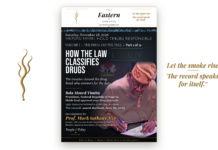
Treaties and Schedules: How the Law Classifies Drugs
Part 2 sets out, in the treaties’ own words, the three conventions that bind Nigeria on drugs, the schedules that place methamphetamine, heroin, cocaine and cannabis by danger, the precursor tables that list the chemicals a meth cook needs, and the rule that every drug proceed must be confiscated. It then measures President Bola Ahmed Tinubu against that rule twice: as the holder of the accounts a United States court forfeited in 1993, and as the President who in 2025 refused NDLEA a share of the proceeds it seizes.

Independent editorial judgment. This series is published free of charge, and no sponsor or named party reviewed it before publication. The Right of Reply remains open at [email protected].
The Line
The treaties rank heroin among the most dangerous drugs they control and order its proceeds confiscated. In 1993 a Chicago court applied that rule to $460,000 in an account in Bola Tinubu’s name.
In Plain English
Nigeria is bound by three United Nations drug treaties, and each sorts drugs and chemicals into lists by how dangerous they are. Methamphetamine, the drug sold as Mkpuru Mmiri, sits in Schedule II of the 1971 Convention. Heroin sits in both Schedule I and Schedule IV of the 1961 Convention, the class kept for drugs with “particularly dangerous properties.” Cannabis sits in Schedule I only, since a 2020 United Nations vote took it out of Schedule IV. The chemicals cooks use to make methamphetamine, such as ephedrine, pseudoephedrine and P-2-P, are listed in Table I of the 1988 Convention, which also requires every party to confiscate drug proceeds. A United States court forfeited $460,000 from an account in Bola Tinubu’s name in 1993, in a civil case the government tied to heroin money; he was never charged, and he settled. As President, in June 2025, he refused to sign a bill letting NDLEA keep part of the drug proceeds it seizes.
The Law Says
§ “Subject to the provisions of this Convention, to limit exclusively to medical and scientific purposes the production, manufacture, export, import, distribution of, trade in, use and possession of drugs.”
Single Convention on Narcotic Drugs, 1961, as amended by the 1972 Protocol, art. 4(c), the general obligation of every party. Exhibit A2.1.
Every schedule in the three conventions sets how tightly that limit applies to a given substance, and every table sets how closely a chemical must be watched. Part 2 places methamphetamine, heroin, cocaine, cannabis and the precursors in those lists and reads what each placement requires of the Federal Republic and its President.
Evidence Positions
Documented Treaty text, schedule and table entries, party status, court and agency records, and the President’s own letter.
Reported Accounts of the 1993 Chicago forfeiture and the later litigation as carried by named outlets, and statements of parties.
Inference What each classification requires of Nigeria, and what the President’s record means against the proceeds rule.
Open The sealed FBI and DEA records, the final text of the NDLEA Act, and the assent status of the 2024 penalty amendment.
Record at a Glance
| Record | Classification or date | Exhibit |
|---|---|---|
| Nigeria’s ratification, 1971 Convention on Psychotropic Substances | June 23, 1981 | A2.7 |
| Nigeria’s ratification, 1988 Convention against Illicit Traffic | November 1, 1989 | A2.7 |
| Methamphetamine (metamfetamine) | 1971 Convention, Schedule II | A2.4 |
| Heroin (diacetylmorphine) | 1961 Convention, Schedules I and IV | A2.2 |
| Cocaine; fentanyl | 1961 Convention, Schedule I | A2.2 |
| Cannabis and cannabis resin | 1961 Convention, Schedule I only (removed from IV, December 2, 2020) | A2.2, A2.8 |
| Ephedrine, pseudoephedrine, norephedrine, P-2-P, phenylacetic acid, APAAN, MAPA | 1988 Convention, Table I | A2.6 |
| Acetone, toluene, hydrochloric acid, sulphuric acid | 1988 Convention, Table II | A2.6 |
| Funds forfeited in No. 93 C 4483, N.D. Illinois | $460,000; no criminal charge | A2.10, B2.2 |
| President declines assent to NDLEA amendment bill (proceeds clause) | June 26, 2025 | C2.2, B2.8 |
| FBI and DEA “Glomar” refusals rejected by Judge Beryl Howell | April 2025 | B2.5 |
Why These Colors
1The Obligation Beneath Every Schedule
Since November 1, 1989, when it ratified the 1988 Convention against Illicit Traffic in Narcotic Drugs and Psychotropic Substances, Nigeria has been bound to make the knowing supply of chemicals for drug manufacture a crime and to confiscate the proceeds of every drug offense that treaty names. Its obligations under the 1971 Convention, which controls methamphetamine itself, run from its ratification on June 23, 1981 (Exhibits A2.5, A2.7, D2.5). Beneath both sits the 1961 Single Convention, whose general obligation, quoted at the head of this part, confines drugs to “medical and scientific purposes.” Its penal clause requires each party to make their illicit “cultivation, production, manufacture, extraction, preparation, possession” and trade “punishable offences when committed intentionally,” with serious offenses “liable to adequate punishment particularly by imprisonment” (Single Convention, 1961, arts. 4(c), 36(1)(a); Exhibit A2.1). Those words are binding obligations of the Federal Republic, and the President executes them. DocumentedInference in final sentence
Classification is how the treaties turn that general command into specific duties. A substance’s schedule decides which controls attach to it, and a chemical’s table decides how closely its trade must be watched. For a lawyer, the schedule is the first fact to establish in any drug case, because it fixes the treaty duty in play. A pharmacist reads it as a ranking of danger against medical worth, built from the World Health Organization’s recommendations and settled by vote in the Commission on Narcotic Drugs (Exhibit A2.8). Both readings meet in Igbo land, where the substances on the street sit at the top of the lists and the chemicals that make them sit in the most closely watched table of all. Documented in second sentenceInference otherwise
2Four Schedules for Narcotic Drugs
The 1961 Convention keeps four schedules, and the International Narcotics Control Board publishes them as the Yellow List. Its 65th edition, of July 2026, places heroin, the drug chemists call diacetylmorphine, in both Schedule I and Schedule IV; cocaine and fentanyl sit in Schedule I alone (International Narcotics Control Board, 2026; Exhibit A2.2). Schedule IV is the treaty’s narrowest gate. For any drug “so included,” Article 2(5) requires a party to “adopt any special measures of control which in its opinion are necessary having regard to the particularly dangerous properties of a drug so included.” The same provision allows it to “prohibit the production, manufacture, export and import of, trade in, possession or use” except for research (Single Convention, 1961, art. 2(5); Exhibit A2.1). Documented
Heroin’s double listing is the law’s verdict on its danger, and a pharmacist would give the same one. An opioid of that strength depresses breathing, which is how an opioid overdose kills, and the World Health Organization links close to 80 percent of the world’s drug-attributable deaths to opioids (World Health Organization, 2025; Exhibit B2.10). Cannabis stood beside heroin in Schedule IV until December 2, 2020, when the Commission on Narcotic Drugs voted 27 to 25 to remove it while keeping it in Schedule I (United Nations Office on Drugs and Crime, 2020; Exhibit A2.8). The current Yellow List shows cannabis and cannabis resin in Schedule I only (Exhibit A2.2). International law no longer ranks cannabis among the particularly dangerous drugs, and Part 4 takes that change to its legal conclusion. DocumentedInference in first sentence
3Methamphetamine and the Chemicals That Make It
Methamphetamine is a psychotropic substance, controlled under the 1971 Convention, and the Board’s Green List, 36th edition, places metamfetamine in Schedule II (International Narcotics Control Board, 2025a; Exhibit A2.4). Its placement brings it under Article 20(1), which obliges every party to “take all practicable measures for the prevention of abuse of psychotropic substances” and to treat and rehabilitate those affected (Convention on Psychotropic Substances, 1971, art. 20(1); Exhibit A2.3). Part 1 dated the outbreak against that duty, and the chemistry explains why the duty cannot be met at the clinic door alone. DocumentedInference in final clause
No farm grows methamphetamine. It must be cooked from chemicals, and the 1988 Convention lists those chemicals by name. The Board’s Red List, 23rd edition, of July 2025, places ephedrine, pseudoephedrine and norephedrine in Table I, together with 1-phenyl-2-propanone, the precursor called P-2-P, phenylacetic acid, and the newer pre-precursors APAAN and MAPA from which P-2-P is made. Solvents and acids, among them acetone, toluene, hydrochloric acid and sulphuric acid, sit in Table II (International Narcotics Control Board, 2025b; Exhibit A2.6). Table I is the stricter list. Article 12(1) requires parties to “prevent diversion of substances in Table I and Table II used for the purpose of illicit manufacture of narcotic drugs or psychotropic substances” (Convention against Illicit Traffic, 1988, art. 12(1); Exhibit A2.5). Documented
The treaty does not leave the chemical trade to regulation alone. Article 3(1)(a)(iv) obliges every party to criminalize, when committed intentionally, “the manufacture, transport or distribution of equipment, materials or of substances listed in Table I and Table II, knowing that they are to be used in or for the illicit cultivation, production or manufacture of narcotic drugs or psychotropic substances” (Exhibit A2.5). The laboratory raided at Nise in 2022, and every drum of precursor that reached a village laboratory in Igbo land, therefore mark two failures the treaty forbids: a diversion Article 12 required Nigeria to prevent, and a supply chain Article 3 required it to prosecute. No public record of precursor seizures for the South-East has been located, and Part 11 follows the chemicals to the ports (Exhibit D2.6). Documented in first sentenceInference in second sentenceDocumented as to the search in final sentence
4The Proceeds Rule
Drug law follows the money as closely as the molecule. Article 3(1)(b)(i) of the 1988 Convention obliges every party to criminalize “the conversion or transfer of property, knowing that such property is derived from” a drug offense, “for the purpose of concealing or disguising the illicit origin of the property” (Exhibit A2.5). Under Article 5(1)(a), each party must “adopt such measures as may be necessary to enable confiscation of” the “proceeds derived from offences established in accordance with article 3, paragraph 1, or property the value of which corresponds to that of such proceeds” (Convention against Illicit Traffic, 1988, arts. 3(1)(b)(i), 5(1)(a); Exhibit A2.5). Confiscation is the treaty’s financial sanction, and it reaches money as well as drugs. DocumentedInference in final sentence
President Tinubu has described Nigeria’s version of that rule in his own words. Declining assent to the National Drug Law Enforcement Agency Amendment Bill, 2025, in a letter read on Thursday, June 26, 2025, he wrote that “the bill seeks to give the National Drug Law Enforcement Agency power to retain a portion of the proceeds of drug-related crime” (TheCable, n.d.; Exhibit C2.2). “Currently,” he continued, “all proceeds of crime must be paid into the confiscated and forfeited properties account,” and payments to the recovering body “can only be made by the president, subject to the approval of the federal executive council (FEC) and the national assembly.” The Senate’s copy of the letter invoked section 58(4) of the Constitution, which empowers the President to withhold assent (Aborisade, 2025; Exhibits B2.8, A2.11). His stated reason was transparency: “There is no compelling reason to change the current process, which promotes transparency, as it involves executive and legislative oversight.” Documented
The reason is a lawful one, and this file records it fairly. His letter also fixes a fact of consequence: in Nigeria, every naira confiscated from the drug trade passes, at the point of release, through the President’s personal approval. A bill to let NDLEA keep part of what it seizes reached the President while the agency had never published its seizure figures for the South-East command by command, as Part 1 recorded. The President who holds the final key to drug proceeds carries, as the next section sets out, a proceeds file of his own. Inference

5The President’s Own Proceeds File
In July 1993 the United States filed a civil forfeiture action, No. 93 C 4483, in the District Court for the Northern District of Illinois, against funds in bank accounts in the name of Bola Tinubu (Exhibit A2.10). The case rested on an affidavit by Kevin Moss, a special agent of the Internal Revenue Service, alleging that the money was tied to the proceeds of a Chicago heroin-trafficking network that operated from about 1988 to 1991 (Onah, 2026; Exhibit B2.2). Reproduced excerpts of the forfeiture judgment state that the funds “represents proceeds of NARCOTICS” and cite the federal money-laundering statutes, 18 U.S.C. §§ 1956 and 1957 (Sahara Reporters, 2009; Exhibit B2.3). Under the law then in force, forfeiture could rest on probable cause, which the Congressional Research Service defined as “a reasonable ground for belief of guilt, supported by less than prima facie proof but more than mere suspicion” (Congressional Research Service, 2000; Exhibit A2.9). Part 16 sets out the full certified record (Exhibit D2.3). Documented as to the case number and courtReported as to the affidavit and excerptsDocumented in final two sentences
Tinubu contested the action at first, saying the money belonged to him, his wife and his foster mother. The case never went to trial. Under an agreed resolution approved by Judge John A. Nordberg in the autumn of 1993, $460,000 in the First Heritage Bank account was forfeited to the United States, and the Citibank account and the balance above that sum were released to him (Onah, 2026; Sahara Reporters, 2009; Exhibits B2.2, B2.3). He was never criminally charged, he has consistently denied wrongdoing, and his lawyers stress that the decision ran against the accounts in his name and never against him (Sahara Reporters, 2023; Exhibits B2.2, B2.7). A civil forfeiture is a judgment against property and carries no conviction; this file accuses him of no crime. Settlement by agreement records no finding of guilt, and the published record shows no admission; it does record that $460,000 was given up rather than carried to judgment. The heroin alleged in that record is the drug the 1961 Convention ranks in Schedule IV for its “particularly dangerous properties,” and the sanction the court applied is the confiscation of proceeds that Article 5 of the 1988 Convention asks every party, Nigeria included, to enable. Reported in first three sentencesDocumented in fourth and fifth sentencesInference in final sentence
Every naira confiscated from the drug trade passes, at the point of release, through the President’s personal approval.
Nigerian courts have weighed the same file and drawn the civil line firmly. In September 2023 the Presidential Election Petition Court held that “the forfeiture order against Tinubu was in a civil and not criminal matter” and that he “was neither arraigned nor convicted in the US over any alleged crime to warrant his disqualification” (Enumah, 2023; Exhibit B2.4). A 2003 letter from the United States Consulate in Lagos, published that year, said FBI records showed no arrests, wants or warrants for him, and his party’s lawyers told the tribunal he “was never indicted for any drug-related offenses” (Ijaseun, 2023; Exhibit B2.1). That counter-evidence belongs in this file, and it stands. DocumentedReported as to the 2003 letter
What the federal agencies hold about the 1993 investigation is still being fought over in Washington. In April 2025, in a Freedom of Information Act suit brought by Aaron Greenspan, Judge Beryl Howell of the District Court for the District of Columbia rejected the FBI’s and DEA’s refusal to confirm or deny that records existed, calling those “Glomar” responses “neither logical nor plausible” (Pulse Nigeria, 2025; Exhibit B2.5). By August 2026 she was setting deadlines for the Justice Department’s production, noting that the case “had already been pending for more than three years,” and the FBI has since lodged its 1993 investigation records with her under seal for private review (Sahara Reporters, 2026; Premium Times, 2026; Exhibits B2.6, C2.1). The Presidency, through its spokesman Bayo Onanuga, calls the suit “a civil records-disclosure dispute” and says it “is not a criminal case against President Bola Ahmed Tinubu” (Exhibit C2.1). Those records remain sealed, no finding in this series depends on what they contain, and the Presidency has not answered this series (Exhibits D2.4, C2.3). DocumentedReported as to the August 2026 deadlineOpen in final sentence
6The Act That Carries the Treaties
Treaties bind the Federal Republic, but a Nigerian court tries drug offenses under the National Drug Law Enforcement Agency Act, which establishes NDLEA as the federal agency for drug control and creates the domestic crimes the conventions require (Exhibit A2.12). In November 2024 the National Assembly harmonized an amendment prescribing life imprisonment for storing, transporting or concealing illicit drugs (Aborisade, 2024; Exhibit B2.9). No record of presidential assent to that amendment has been located, and the 2025 bill the President declined in June concerned the retention of proceeds (Exhibits D2.2, C2.2). An authoritative consolidated text of the Act, with every amendment, could not be retrieved in readable form for this installment, so this part quotes no section of it (Exhibit D2.1). DocumentedDocumented as to the searches in final two sentences
A drug statute whose current text the public cannot readily read, and whose newest penalties cannot be shown to be law, is a weak instrument against cooks who read nothing but the market. The schedules tell Nigeria exactly what to hunt: a Schedule II stimulant, the Table I chemicals that make it, and the proceeds that pay for it. Part 1’s enforcement record, with cannabis seized in Ebonyi at more than 1,800 times the weight of methamphetamine, shows an agency hunting lower on the list than the law points. Inference
◆What Stands
Classification settles what Nigeria owes. Under a treaty Nigeria ratified in 1981, methamphetamine is a Schedule II psychotropic substance; its precursors sit in Table I of a treaty Nigeria ratified in 1989; heroin sits in the 1961 Convention’s most restrictive schedule; and cannabis has stood outside that schedule since 2020. Each placement is a binding instruction to the Federal Republic, and each instruction runs to the office that holds its executive power. DocumentedInference in final sentence
That office is held by the man whose accounts yielded the $460,000 a United States court forfeited in 1993 as alleged heroin proceeds, in a civil case that charged him with nothing. In June 2025 he refused to loosen a regime under which every naira Nigeria confiscates from drugs is released only with his approval. The treaties do not ask whether such a President is guilty of anything. They ask whether the state he leads has prevented the abuse, cut the chemicals, prosecuted the supply and confiscated the money, and on the record set out in this volume so far, the Federal Republic cannot yet show that it has. Documented in first sentenceInference in second
The Finding
The record establishes that Nigeria is bound by the 1961, 1971 and 1988 conventions. Methamphetamine sits in Schedule II of the 1971 Convention, and its main precursors are Table I chemicals; heroin is listed in Schedules I and IV of the 1961 Convention, cannabis in Schedule I only; and the 1988 Convention requires the confiscation of drug proceeds. It establishes that $460,000 in an account in Bola Tinubu’s name was forfeited in 1993 in a civil action the United States tied to heroin proceeds, without any criminal charge, and that as President he holds final approval over the release of Nigeria’s confiscated drug proceeds.
The Request
The President of the Federal Republic of Nigeria: publish the instrument of assent or refusal for the NDLEA amendment harmonized in November 2024, and a consolidated, current text of the NDLEA Act.
The Attorney-General of the Federation: publish the annual accounts of the Confiscated and Forfeited Properties Account showing drug proceeds received and released since May 29, 2023.
The Chairman, NDLEA: publish seizures of ephedrine, pseudoephedrine, P-2-P, APAAN and other Table I chemicals by command for 2021 to 2026.
The Presidency: consent in writing to the release of the 1993 FBI and DEA records now under seal in Washington, since the personal-privacy interests the agencies may cite are the President’s to waive.
What is asked of each office is already in its files or within its power.
Next: Part 3 takes the seven families of drugs one by one, as a pharmacist would, from stimulants and opioids to inhalants and cannabinoids, and maps each to the drugs Nigerians use.
Trace the record. Document the evidence. Build the proof until denial has nowhere left to stand.
Source Note
This part relies on Exhibits A2.1 to A2.12, B2.1 to B2.10, C2.1 to C2.3 and D2.1 to D2.6. Nigeria’s ratification dates come from the International Trade Centre’s treaty database; the United Nations Treaty Collection status page could not be retrieved (Exhibit D2.5). Treaty text is quoted from copies hosted by the World Trade Organization and the National University of Singapore. Schedule and table entries come from the International Narcotics Control Board’s Yellow List (65th edition, July 2026), Green List (36th edition, 2025, read in the Swissmedic copy) and Red List (23rd edition, July 2025, read in the European Union Drugs Agency copy). Accounts of the 1993 case differ on dates: one gives an agreed order of September 15, 1993, another a dismissal on September 21 and a forfeiture order on October 4, so this part says only that the matter ended in the autumn of 1993. Sahara Reporters’ 2009 publication, a secondary source, supplies the judgment excerpts; the full certified record was not re-read for this part. The quoted “represents” follows the excerpt as published. TheCable’s report of the House reading supplies the quoted letter; ThisDay reports its reading in the Senate. Some reporting has called Tinubu “indicted”; no indictment exists in any record located, and this file does not use the word for him. The tagline’s reference to “the most dangerous drugs” rests on heroin’s Schedule IV listing. Days of the Tinubu presidency run from May 29, 2023, so November 28, 2026 is Day 1,279.
§Evidence Docket
Every record this installment relies on, by class, with a link to the source wherever one exists. 31 records.
Class A · Legal Instruments and Technical Specifications
A2.1Single Convention on Narcotic Drugs, March 30, 1961, as amended by the Protocol of March 25, 1972, arts. 2(5), 4(c), 36(1)(a).
Open the source ↗
A2.2International Narcotics Control Board. (2026). List of narcotic drugs under international control (Yellow List, 65th ed.).
Open the source ↗
A2.3Convention on Psychotropic Substances, February 21, 1971, 1019 U.N.T.S. 175, art. 20(1).
Open the source ↗
A2.4International Narcotics Control Board. (2025a). List of psychotropic substances under international control (Green List, 36th ed.).
Open the source ↗
A2.5United Nations Convention against Illicit Traffic in Narcotic Drugs and Psychotropic Substances, December 20, 1988, arts. 3(1)(a)(iv), 3(1)(b)(i), 5(1)(a), 12(1).
Open the source ↗
A2.6International Narcotics Control Board. (2025b). List of precursors and chemicals frequently used in the illicit manufacture of narcotic drugs and psychotropic substances under international control (Red List, 23rd ed.).
Open the source ↗
A2.7International Trade Centre. (n.d.). LegaCarta: Convention on Psychotropic Substances; United Nations Convention against the Illicit Traffic in Narcotic Drugs and Psychotropic Substances.
Open the source ↗
A2.8United Nations Office on Drugs and Crime. (2020, December 2). CND votes on recommendations for cannabis and cannabis-related substances [Press statement].
Open the source ↗
A2.9Congressional Research Service. (2000, March 29). Civil Asset Forfeiture Reform Act: Overview of S. 1931 and H.R. 1658, 106th Congress (RL30237).
Open the source ↗
A2.10United States District Court for the Northern District of Illinois. (1993). Civil forfeiture proceeding, No. 93 C 4483.
See The Sealed Years docket
A2.11Constitution of the Federal Republic of Nigeria 1999 (as amended), ss. 5(1), 58(4).
Not linked
A2.12National Drug Law Enforcement Agency Act, Cap. N30, Laws of the Federation of Nigeria 2004 (as amended).
Not linked
Class B · Contemporaneous Reporting
B2.1Ijaseun, D. (2023, April 12). Timeline of how Tinubu’s buried drug case resurfaced. BusinessDay.
Open the source ↗
B2.2Onah, K. (2026, September 3). What Tinubu’s 1993 US case actually was, and what it wasn’t. CrispNG.
Open the source ↗
B2.3Sahara Reporters. (2009, February 18). Bola Tinubu’s heroin-tainted assets forfeiture judgement.
Open the source ↗
B2.4Enumah, A. (2023, September 6). $460,000 forfeiture: No evidence of conviction against Tinubu, tribunal tells Obi. ThisDay.
Open the source ↗
B2.5Pulse Nigeria. (2025, April 13). US court orders FBI, DEA to release records on Tinubu’s drug probe.
Open the source ↗
B2.6Sahara Reporters. (2026, August 18). US judge sets new deadline to release records on allegations linking Tinubu to drug trafficking.
Open the source ↗
B2.7Sahara Reporters. (2023, April 11). Forfeited drug-linked $460,000: Decision was against accounts in Tinubu’s name, not Tinubu.
Open the source ↗
B2.8Aborisade, S. (2025, June 26). Tinubu rejects NDLEA amendment bill over transparency, constitutional concerns. ThisDay.
Open the source ↗
B2.9Aborisade, S. (2024, November 22). National Assembly prescribes life jail for drug offenders, traffickers. ThisDay.
Open the source ↗
B2.10World Health Organization. (2025, August 29). Opioid overdose [Fact sheet].
Open the source ↗
Class C · Responses of the Presidency
C2.1Premium Times. (2026, September 3). UPDATED: US court case on Tinubu’s past forfeiture is civil, not criminal matter – Presidency.
Open the source ↗
C2.2TheCable. (n.d.). Tinubu rejects NDLEA bill, says agency can’t keep proceeds of drug-related crimes.
Open the source ↗
C2.3The Presidency, Federal Republic of Nigeria. Response to this series.
[email protected]
Class D · Records Not Retrieved
No inference is drawn from the absence of these records.
Previously Published in This File
| Installment | Description |
|---|---|
| Mkpuru Mmiri: Hold Tinubu Responsible — Vol. I Overview | Series terms, the drug families, the binding law, the counter-evidence and the requests; 51 exhibits. |
| Part 1 of 21: The Outbreak on Record: Mkpuru Mmiri, 2021 to 2022 | The outbreak dated against the treaty duty, federal notice from November 25, 2021, and the requests for an emergency; 43 exhibits. Link to follow on publication. |
§Legal Sources and References
Legal Sources
- Constitution of the Federal Republic of Nigeria 1999 (as amended), ss. 5(1), 58(4).
- National Drug Law Enforcement Agency Act, Cap. N30, Laws of the Federation of Nigeria 2004 (as amended).
- Single Convention on Narcotic Drugs, March 30, 1961, as amended by the Protocol of March 25, 1972, arts. 2(5), 4(c), 36(1)(a). https://www.importlicensing.wto.org/sites/default/files/members/6/Single%20Convention%20on%20Narcotic%20Drugs%201961_25.03.1972.pdf
- Convention on Psychotropic Substances, February 21, 1971, 1019 U.N.T.S. 175, art. 20(1). https://cil.nus.edu.sg/wp-content/uploads/2022/07/1971-Convention-Psychotropic-Substances.pdf
- United Nations Convention against Illicit Traffic in Narcotic Drugs and Psychotropic Substances, December 20, 1988, arts. 3, 5, 12. https://www.importlicensing.wto.org/sites/default/files/members/6/Convention%20Against%20Illicit%20Traffic%20in%20Narcotic%20Drugs%20and%20Psychotropic%20Substances%201988_20.12.1988.pdf
- International Narcotics Control Board. (2025a). List of psychotropic substances under international control (Green List, 36th ed.). https://www.swissmedic.ch/dam/swissmedic/en/dokumente/bewilligungen/btm/conversion_factorspsychotropics.pdf.download.pdf/conversion_factorspsychotropics.pdf
- International Narcotics Control Board. (2025b). List of precursors and chemicals frequently used in the illicit manufacture of narcotic drugs and psychotropic substances under international control (Red List, 23rd ed.). https://www.euda.europa.eu/system/files/documents/2026-03/red_list_e.pdf
- International Narcotics Control Board. (2026). List of narcotic drugs under international control (Yellow List, 65th ed.). https://www.swissmedic.ch/dam/swissmedic/en/dokumente/bewilligungen/btm/conversion_factorsnarcotics.pdf.download.pdf/conversion_factorsnarcotics.pdf
- United States District Court for the Northern District of Illinois. (1993). Civil forfeiture proceeding, No. 93 C 4483.
References
- Aborisade, S. (2024, November 22). National Assembly prescribes life jail for drug offenders, traffickers. ThisDay. https://www.thisdaylive.com/2024/11/22/national-assembly-prescribes-life-jail-for-drug-offenders-traffickers/
- Aborisade, S. (2025, June 26). Tinubu rejects NDLEA amendment bill over transparency, constitutional concerns. ThisDay. https://www.thisdaylive.com/2025/06/26/tinubu-rejects-ndlea-amendment-bill-over-transparency-constitutional-concerns-2/
- Congressional Research Service. (2000, March 29). Civil Asset Forfeiture Reform Act: Overview of S. 1931 and H.R. 1658, 106th Congress (RL30237). https://www.everycrsreport.com/files/20000329_RL30237_6d85d335aa55cbdd2a02e3aa9f0e044677737c6e.html
- Enumah, A. (2023, September 6). $460,000 forfeiture: No evidence of conviction against Tinubu, tribunal tells Obi. ThisDay. https://thisdaylive.com/index.php/2023/09/06/460000-forfeiture-no-evidence-of-conviction-against-tinubu-tribunal-tells-obi
- Ijaseun, D. (2023, April 12). Timeline of how Tinubu’s buried drug case resurfaced. BusinessDay. https://businessday.ng/news/article/timeline-of-how-tinubus-buried-drug-case-resurfaced/
- International Trade Centre. (n.d.). LegaCarta: United Nations Convention against the Illicit Traffic in Narcotic Drugs and Psychotropic Substances. https://legacarta.intracen.org/instrument/798466-united-nations-convention-illicit-traffic-narcotic-drugs-psychotropic-substances
- Nze, M. (2026, November 26). Mkpuru Mmiri: Hold Tinubu Responsible — Vol. I Overview. The Eastern Updates. https://theeasternupdates.com/2026/11/26/mkpuru-mmiri-hold-tinubu-responsible-vol-i-overview/
- Onah, K. (2026, September 3). What Tinubu’s 1993 US case actually was, and what it wasn’t. CrispNG. https://crispng.com/what-tinubus-1993-us-case-actually-was-and-what-it-wasnt/
- Premium Times. (2026, September 3). UPDATED: US court case on Tinubu’s past forfeiture is civil, not criminal matter – Presidency. https://www.premiumtimesng.com/news/top-news/907280-updated-us-court-case-on-tinubus-past-forfeiture-is-civil-not-criminal-matter-presidency.html
- Pulse Nigeria. (2025, April 13). US court orders FBI, DEA to release records on Tinubu’s drug probe. https://www.pulse.ng/story/us-court-orders-fbi-dea-to-release-records-on-tinubus-drug-probe-2025041315090214576
- Sahara Reporters. (2009, February 18). Bola Tinubu’s heroin-tainted assets forfeiture judgement. https://saharareporters.com/2009/02/18/bola-tinubus-heroin-tainted-assets-forfeiture-judgement
- Sahara Reporters. (2023, April 11). Forfeited drug-linked $460,000: Decision was against accounts in Tinubu’s name, not Tinubu. https://saharareporters.com/2023/04/11/forfeited-drug-linked-460000-decision-was-against-accounts-tinubus-name-not-tinubu
- Sahara Reporters. (2026, August 18). US judge sets new deadline to release records on allegations linking Tinubu to drug trafficking. https://saharareporters.com/2026/08/18/us-judge-sets-new-deadline-release-records-allegations-linking-tinubu-drug-trafficking
- TheCable. (n.d.). Tinubu rejects NDLEA bill, says agency can’t keep proceeds of drug-related crimes. https://thecable.ng/tinubu-rejects-ndlea-bill-says-agency-cant-keep-proceeds-of-drug-related-crimes
- United Nations Office on Drugs and Crime. (2020, December 2). CND votes on recommendations for cannabis and cannabis-related substances [Press statement]. https://www.unodc.org/documents/commissions/CND/CND_Sessions/CND_63Reconvened/Press_statement_CND_2_December.pdf
- World Health Organization. (2025, August 29). Opioid overdose [Fact sheet]. https://www.who.int/news-room/fact-sheets/detail/opioid-overdose
Right of Reply
President Bola Ahmed Tinubu, the Presidency, the Attorney-General of the Federation, NDLEA, the National Assembly and every person named in this installment may respond to any finding in it at [email protected]. Material responses will be published with the date of receipt recorded, and demonstrated factual errors will be corrected and marked.
Editorial Disclosure
The Eastern Updates is published by People & Polity Inc., New York, which through its sister mastheads has published earlier forensic series on President Tinubu’s United States legal record, including The Sealed Years on Africa Today News, New York. These publications have common ownership; repetition among them is not independent corroboration, and no finding in this part rests on them. The author is of Imo State origin. No sponsor has reviewed or paid for this series, which is published free of charge.